St. John of the Cross Poetry Reflections Part 2 At Contemplation

Artistic Spirituality and the Divine Mercy Message

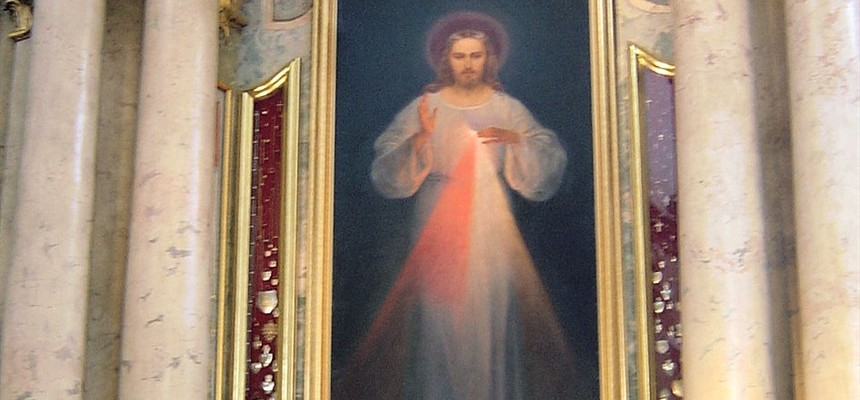
Photo By: Flickr/feelix-Vilnius Divine Mercy
The Diary of St. Faustina Kowalska is most noted for its childlike simplicity, but also depth, in conveying God's love and mercy for humanity through the numerous visions describing Christ's Divine Mercy and in the intimate conversations between St. Faustina and Christ Himself, which she recounts in her diary. In a deeper examination of the text, St. Faustina offers some insights into the spirituality of the arts that can help to inspire and direct the work of artists.
The Diary is full of beautiful imagery of Jesus' Divine Mercy, including the image familiar to most, where Jesus stands radiant in a flowing white garment with red and light blue rays streaming forth from his heart, signifying the blood and water shed for sinners at his crucifixion. Not only is this an image of a cleansing from sins, but also signifies that the various forms of art, be it a painting, a piece of literature or prose, or even a well done film or musical piece, can have potential to shed God's graces upon those beholding the artistic piece. Art aided by the hand of the Holy Spirit can serve to be a "watershed" of grace reaching the ends of the earth cleansing the culture from darkness and sin through various artistic means in the same way that Christ's blood and water is shed for the cleansing of our souls. All of this is brought about because sacred art reveals attributes of God and the Divine, such as beauty. One can come to know something of the beauty of God in the beauty of an artistic piece. We not only find that God is loving and merciful, but dazzlingly beautiful in beholding the Divine Mercy image.
Holy art turns toward the Eucharistic mystery, the source and summit of our Catholic faith, and follows this inspiration by feeding the soul. Serving an iconographic role, sacred art uses the senses to bring God's truth to a soul. In so doing, if one who sees or hears the artistic piece through the senses is open to inspiration, then he can be moved by God's grace communicated through the presence of art. For example, St. Faustina uses a stunning image to help readers of her diary understand the extent to which Jesus is willing to sacrifice himself in order that his mercy be brought to all mankind. St. Faustina describes that at each Mass she attends, she sees the infant Jesus on the altar with the priest. At Holy Communion, she sees the priest eat the infant Jesus in place of the Host.
The artist realizes the limitations of pursuing sacred artistic projects in reading St. Faustina's diary. St. Faustina spent a tremendous amount of time agonizing over finding an artist to best capture her vision of the Divine Mercy by way of painting. She soon found out that even the best painter could not come close to fully rendering the beauty and majesty of the actual Divine Mercy image she saw in her visions from Jesus. Yet, even the painted image that best depicts the Divine Mercy still has the potential to move a soul in spite of all worldly limitation. Mysteriously and paradoxically, God in his majesty and incomprehensibility, touches our hearts in a simple and personal manner by tantalizing our senses with beautiful holy art of otherworldly proportions. St. Faustina says of this, "I understand how much God loves us, how simple he is, though incomprehensible, and how easy it is to communicate with him, despite his majesty," (Diary of St. Faustina Kowalska, 603). Thus, in the midst of these limitations, the artist must always practice patience and never cease persevering in his artistic endeavors for it is patience in adversity that brings forth power to the soul, (Diary, 608).
The artist would do well to read The Diary of St. Faustina Kowalska. Through it, the artist will come to understand just how important the role that art plays in witnessing God's Good News of love and mercy to others. The artist too, will realize how limited he is in fully capturing God's attributes, but at the same time, the artist will also come to realize that art is still able to touch the soul in spite of these worldly limitations. Therefore, the artist must persevere in his artistic pursuits in order to bring forth a shedding of grace to the world, a "watershed" that transforms the culture from that of darkness to light, so that everyone may be able to know God's mercy and come to love him.
Recommended Stories
About the Author
Tim is a 2006 graduate of Franciscan University of Steubenville in Ohio with a BA in Catechetics. Previously he completed studies in Theology and Catholic literature at Our Lady of Corpus Christi Liberal Arts Institute in Corpus Christi, Texas, where he resides. Tim has contributed articles for his diocesan newspaper,The South Texas Catholic and served as Publications Coordinator for print media productions for an apostolate dedicated to spreading the Good News through print, video and audio productions as well as outreach and ministry to budding artists. Tim enjoys writing about the Catholic faith, especially in regards to its beautiful and rich literary patrimony.
More Stories By :