Catholic Masculinity Today

Confession: my meeting with Jesus

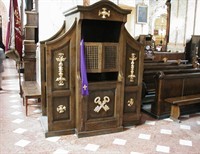
Photo By: Flickr/Dwayne-inside confessional
Confession seems to be something seldom practiced in the early 21st century American Catholic Church. If you’ve been away from this practice for years, the prospect of entering a little room to tell a religious figure all the things you did that you are ashamed of can be daunting (I speak from experience).
Whether you’ve been away from Confession for a long time or whether you go on a weekly basis, it can be helpful to reflect of what it was designed to be in the first place; a personal encounter with Jesus Christ, a loving assurance that our guilt is erased by His blood, our own experience of the Father embracing the prodigal son (or daughter).
In order to learn the purpose of Confession, we need to start from the beginning of Church history. For those of us who may be wondering “Why do I have to go to a priest? Doesn’t God forgive sins?” God is indeed the one who forgives sins, but Jesus granted priests and bishops the authority to forgive sins in his name (John 20:21-23). But even then, Jesus did not prescribe a particular ritual for the forgiveness of sins. The practice of Confession, as we know it today, is the product of evolutionary process, beginning in the earliest days of the Church.
Originally, the major reconciliation ritual was reserved for major, public sins such as adultery or murder, and consisted of a period of prayer and fasting before being welcomed back by the bishop on the community’s behalf (Santa, 274). The practice of disclosing a wider array of sins to one person developed out of mentorships in the monastic tradition, beginning in the fifth century. The practice gained the wide acceptance of the people and of the hierarchy over the next few centuries, in part because it offered a personal assurance, or affirmation, of divine forgiveness (Santa, 275-276). And here is when we come to a very important point: affirmation. Confession is not about reminding you of how sinful you are (although we need to approach the Sacrament in humility), but to remind us that God reaches out to us in love; he wants to unburden us from are guilt, to live with the guarantee that our sins, once repented, no longer matter in our lives. We can leave them behind us.
Let’s move forward in time to the 1930s; Jesus is appearing to a young religious sister named Maria Faustina Kowalsaka (later canonized by Pope John Paul II). In these particular revelations He sends a message about His Divine Mercy. He wants sinners to trust in his forgiving love: “I do not want to punish aching mankind, but I desire to heal it, pressing it to My Merciful Heart.” (Diary, 1588) Jesus also describes to St. Faustina how He dispenses graces in the Sacrament of Reconciliation: “When you approach the confessional, know this, that I Myself am waiting there for you. I am only hidden by the priest, but I Myself am acting in your soul.” (Diary, 1602)
We need to remember that we are not talking about our sins to some stranger, or to someone who happens to be our favorite cleric. Rather, we are bringing our sins to the One who already knows what we have done and the graces that we need. Besides, every priest is bound by the seal of Confession not to repeat what a penitent says, so we can be sure our own scandals won’t become the town’s latest gossip material.
The key to a positive experience with Reconciliation is trusting in God’s love. Because of confessions, we don’t have to linger with doubts inside our minds about whether we are forgiven by God, because he has verbally absolved us through the ministry of the priest!
In conclusion, if you have been away from Confession for whatever period of time, please don’t be intimidated. God is waiting to embrace you with open arms inside that little room.
Works Cited:
John. The Catholic Study Bible. Second Vers. Oxford: Oxford UP, 2011. Print.
Kowalska, Faustina. Appendix Two: Diary of St. Faustina. Consoling the Heart of Jesus. Ed. Michael E. Gaitley. N.p.: Marian Fathers of the Immaculate Coneption of the B.V.M., 2010. 253-382. Print.
Santa, Thomas M., C.Ss.R. Understanding Scrupulostiy: Questions, Helps, and Encourement. Liguori: Liguori/Triumph, 2007. Print.
Recommended Stories
About the Author
I am a seminarian for the Diocese of Orlando, studying at Pope St. John XXIII National Seminary. I am also a proud 4th degree member of the Knights of Columbus. My hobbies are exploring historical cities, singing, and reading books on history, ghost stories, and Jane Austen novels.
More Stories By :