Answers to a Non-Catholic

The Second Advent Part 2

Photo By: Flickr/Medill News21
“For the time will come when they will not endure sound doctrine; but after their own lusts shall they heap to themselves teachers, having itching ears; And they shall turn away their ears from the truth, and shall be turned unto fables.” (2 Timothy 4:3-4)
In Part 1 we began looking at the Second Advent from the viewpoint of the Saint Paul’s admonishments to Saint Timothy concerning the state of professing Christianity as we approach that Second Coming. We saw how the day warned about by Paul finally came about in 1517 and continues on to this day…and beyond. The Protestant Revolt turned people’s ears from the Truth in unprecedented numbers due to the invention of the printing press. In this part we will look at what fruit this Revolt has borne: the “fables” of which the Saint spoke
Fable Number 1: The Five Solae
It begins with Sola Scriptura and on it the other four hinge. Even though the doctrine is nowhere supported in Scripture they devised this fable to say, “You don’t need the Magisterium! You have the Holy Spirit! You can interpret the Bible for yourself.” But before they could limit doctrinal source to the Bible they had to first limit the Bible. Purgatory, in particular, was a thorn in the side of Martin Luther. But those pesky Deuterocanonical Books supported it…what to do?
The solution arrived at was the same solution that the Jewish hierarchy arrived at the so called “Council of Jamnia” around 90 AD. “Since those books support doctrines with which we don’t agree let’s get rid of the books.” Up to that time The Septuagint was the Old Testament used throughout Judaism…in fact it was the Scriptures read by Jesus and the Scriptures which the Apostles preached. But now the “canon” was changed to eliminate those books and Luther took the same course of action. So in practice Sola Scriptura doesn’t only mean “Scripture Only” but “OUR Scriptura Only”.
Fable Number 2: T.U.L.I.P
Once Pandora’s Box was open by a limited Bible and no accountability for interpretation save the supposed inspiration of each believer more and more “new doctrine” began to emerge. John Calvin’s theology now called “Calvinism” departed from the Lutheran theology and supposedly is firmly entrenched in Scripture. The problem is that many, if not most, Evangelical Christians disagree with the “Five Points” as they are called. Especially galling to many Evangelicals are the “U” which stands for “unconditional election”, the “L” which stands for “Limited Atonement” and the “P” which stands for “Perseverance of the Saints” or “Once Saved. Always Saved” for short. Unconditional Election means that God has made certain people for Heaven and certain people for Hell and there is nothing we can do about it. Limited Atonement means that Jesus didn’t die for the world but only for the “elect”. Perseverance of the Saints (meaning the “elect” not the Saints as we use the term) means that there is nothing one can do to lose their salvation since they did nothing to obtain it.
Fable Number 3: Sinless Perfection or Second Blessing
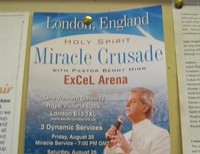
This fable originated with John and Charles Wesley in the 18th Century. It was an offshoot of Anglicanism (Church of England) and basically teaches that there is a separate work of the Holy Spirit or “Second Blessing” that empowers the believer to live in a state of sinless perfection. This is generally called “Methodism” and is the root of much of what you see and hear on so-called “Christian” television today. I’ll explain…
Eventually, as Methodist churches became more and more “liberal” in the eyes of some people (remember, private interpretation is the rule) they broke off and began new denominations that held to the “old beliefs”. From Methodism came the “Holiness” churches (with their rules about dress, hair, jewelry and make up), the Church of the Nazarene (a bit more relaxed version of the Holiness) and eventually what we know today as “Pentecostalism” (which is broken into Trinitarian and Oneness…a story for another day)
Much of what you see on networks like Trinity Broadcasting is rooted in Pentecostalism. Pentecostal theology took the idea of the “Second Blessing” of Methodist theology and, beginning with the “Azusa Street Revival” of 1906-1915 turned it into “The Baptism of the Holy Spirit” …with the initial evidence of “speaking in tongues”. This fable would have an impact of both the Evangelical Christians (and to a lesser extent the Church) and the world as we will see in the third and final Part.
Recommended Stories
About the Author
I was a Cradle Catholic from the time that I was born through my teen years. I slowly moved away from the Church and as a young adult I became an Evangelical Christian. I spent nearly 40 years in various types of ministry as a teacher, preacher, pastor or evangelist. But my main area of expertise was Apologetics…what we believe and why we believe it. I am a graduate of Central Christian College of the Bible in Moberly, MO with a Bachelor of Science in Biblical Studies. In November of 2014 I retired to the Philippines, where my wife Rose is from. We live in the mountains of Negros Oriental in the small town of Canlaon City with our many brothers and sisters, nephews and nieces (to whom I am “Daddy Mike”).
Nine years ago I reverted to the Catholic Church. I have try to write articles which inform, instruct and equip our Catholic brothers and sisters while avoiding using jargon. I have also sought to defend the Faith with our several Protestant visitors in as kind a way as possible
My archive here, which now contains nearly 80 articles, is located at http://www.catholic365.com/author/mike-bugal/
I may also be contacted via email at mbugal@yahoo.com