Remember the Reason for the Season
Sponsored

Catholic365 is sponsored by
Road to Purity



“Your dead shall live, their bodies shall rise. O dwellers in the dust, awake and sing for joy!” Isaiah 26:19
Be holy as I am holy. (Lev 19:2)
Be perfect as I am perfect. (Mt 5:48)
Your body is a temple. Our bodies are not punishments. They are gifts. It is easy to think of our bodies as being at fault for many of our sins, but that is not fair.
It’s a cover up. We blame our bodies for a lot of things, when really the things they truly and deeply desire are not bad. It is the way we’ve gone about fulfilling those desires that is wrong. Often using the quick fix, we fill ourselves with something shallow that leaves us still feeling quite empty and unsatisfied.
Jesus points out at the Sermon on the Mount that “lust is first and foremost a problem of the heart, not the body.” (Theology of the Body for Beginners by Christopher West)
“...everyone who looks at a woman lustfully has already committed adultery with her in his heart.” Mt 5: 28
We blame our bodies for the lack of discipline in spirit when all they desire is to be whole again, to live fully as God intended, perfectly reflecting His image. Our body and spirit should be in unity. As the Father, Son and Holy Spirit are one, so should our natures be, but instead we are divided.
We have made our bodies scapegoats where we lay our blame and wish it cast aside. But, in reality, our souls play an equal, if not greater role, in resisting what is evil. So many of us have given in to the ideology that our bodies are bad, that they are corrupt and the source of our sin. We have grown up to think that if only we were liberated of our body, we would be good.
It is all a lie.
A lie I didn’t even know I believed. A lie that no one told, but they didn’t have to. It was unfortunately implied, embedded in society, and it has devastated generations. This Hellenistic way of thinking is poisonous and it must be cut off, burnt out, like chaff from the threshing floor.
The Hellenistic belief that our body is a trap, rejects the resurrection of the body. But, as Saint Paul says to the Corinthians, “If the dead are not raised: ‘Let us eat and drink, for tomorrow we die.’” (1 Cor 15:32) Our hope, our suffering, our faithfulness, it is all in vain without the resurrection. We need the resurrection to transform our body.
As it is now, our body is “but a bare kernel”, but it will be transformed into the fullness that God originally intended (1 Cor 15:37). Our body has eternal meaning. It is meant to be resurrected, to be filled with the life of the Spirit (Rom 8:11). Our body without the Spirit of God is the image without the likeness, it is the creation lacking the Creator.
On the day of resurrection, our bodies will rise. We will shed our old self and put on the new. We shall no longer be like monsters, our souls separated from our bodies. We will be whole again, a complete person. For, it is not just the soul called to eternal life, but the complete person, the soul joined to the body (Theology Of the Body for Beginners by Christopher West, page 97).
Our body and soul are a unity (CCC 364-365). They are created together in an instant by God (CCC 366). It was the sin of man that separated them. And it is the hope of man that they will be reunited at the Final Resurrection.
My body is good.
My soul is good.
And I require both to get into heaven.
This is why we have the pillars of both faith-for the soul- and works- for the body. To have the outward sign of our inward beliefs. Sacraments are dual for this purpose as well, to fulfill our bodies and spirits. We need this duality in our faith to fulfill the duality in which we were created.
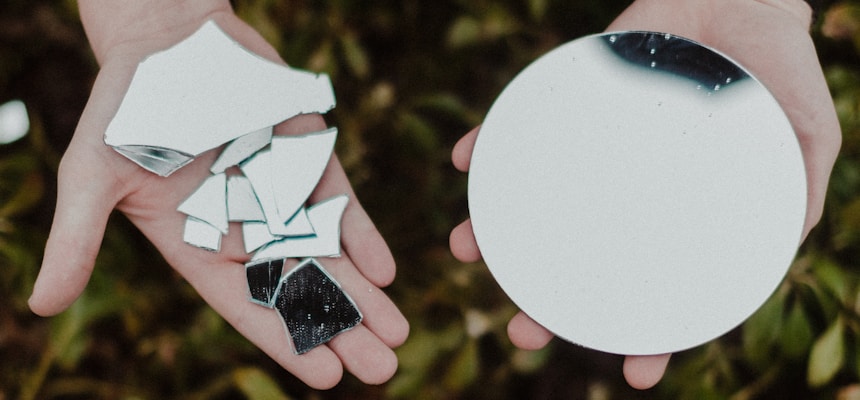
Our humanity is a symbolon. ‘Symbolon’ is a Greek word meaning half of a broken object where “the parts [are] placed together to verify the bearer’s identity” (CCC 188). After the fall, our nature was divided, it did not work in unison anymore. We are still good, but broken.
It is only in Christ’s death and resurrection that our beings have the hope of once again being one perfect unified nature as before the fall. Jesus came to rectify our original sin and to re-unify us in His Body, the one body of the Church, in communion, body and blood, soul and divinity, so that our two parts may be placed back together that we may verify our new identity as sons and daughters of God.
Jesus Christ, being fully God and fully man, shares in our nature, having a body and a soul. God made man and became man to redeem the world, humbling Himself by taking on the human nature which is made in likeness of His own Divine Image. And just as Adam said when seeing his bride, “This at last is bone of my bones and flesh of my flesh” (Gen 2:23), so too can we rejoice that our God, the New Adam, is bone of our bone and flesh of our flesh!
Our God shares in our nature and, in His death and resurrection, has redeemed us all.
Mikalah has always had a passion for writing. As a young homeschool mom of three sweet boys, she enjoys getting to share her faith through her love of writing.