Communion: Tongue or Hand?

Introduction to The Trinity

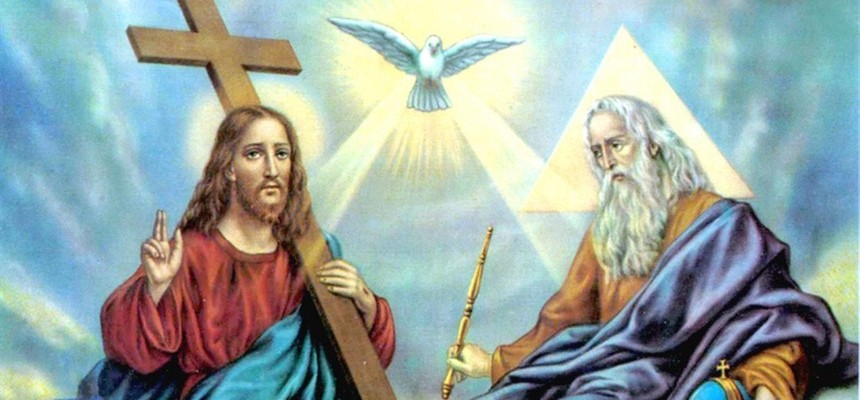
Photo By: Flickr/Waiting For The Word
The nature of God is a subject which has been debated among those professing the name "Christian" almost since the beginning of the New Testament era. In Deuteronomy 6:4 we are presented with an apparently plain statement concerning His nature: "Hear, O Israel! The LORD our God, the LORD is One". However, even a cursory glance at the balance of the Word of God quickly makes it clear that such a statement is anything but "plain". An in-depth study on the subject makes it even less "apparent"... presenting what appears at times to be contradictory views of God. Okay, in Deuteronomy Moses says "God is one".
Yet right in the beginning of his writings, the book of Genesis, he shows God the Creator (Genesis 1:1) and mentions the Spirit of God as a distinct entity "...And the Spirit of God moved upon the face of the waters" (Genesis 1:3b). Then within the same chapter, as God is about to create man, we read "And God said, Let us make man in our image, after our likeness..." (Genesis 1:26a). Is God "one" or is He "two".... or "three"?? Or does the word "one" have a deeper meaning than a mere mathematical concept? Thus man has struggled with God's nature... and formulated several doctrines to try to get their finite minds to grasp the Infinite God.
Two Opposing Views
Two such formulations, and the ones most common today among professing believers, are the "Modalist" view and the "Trinitarian" view. I will not endeavor to relate the history of each since excellent articles already exist online detailing those histories. Simply put the former teaches that God has appeared at various times in human history in various "roles, titles or offices" or "modes" (thus the name "Modalist"). I sometimes use the analogy of an old time actor playing several roles in the same play back in the Ancient Greece or Rome.. They would wear a mask to represent each character. An in-depth delineation of this view may be found by reading David K Bernard's book "The Oneness of God". Stating this position in the most simplistic form "God is: the Father in creation, the Son in the Incarnation and the Holy Ghost indwelling believers today".
While this appears reasonable on the surface, it requires that one overlook several things about the nature of the Father, the Son and the Holy Spirit that the Word of God plainly states... such as Their relationship one to another (said relationship is impossible between mere "roles, titles or offices") or how They speak about one another (in the third person singular). On the other hand, the latter doctrine... the Trinity... does not require these aspects be overlooked. There are objections, however, that its opponents raise.
A Couple Of Commonly Presented Objections
One of the first things that opponents of the Trinitarian viewpoint will bring up is that the word "trinity" doesn't appear in scriptures. While this is absolutely true, it doesn't mean that the concept described by the word is unscriptural. It should be noted that there are several doctrines that the opponents of the Trinitarian view adhere to whose descriptive words are not in the Bible. For example, nowhere in the English translation of the Scriptures does the words "rapture" or "bible".... or even "Pentecostal"... appear. Trinitarians claim that there are well over 700 verses which support the teaching. We will examine just a few here.
Another argument that non-Trinitarians will try to make is that belief in the Trinity is equal to polytheism. As one proponent of the Oneness Pentecostal position likes to put it, "Like peas in a pod, so are the gods in their squad". They teach that the doctrine of the Trinity says that there are THREE Gods. This is not at all what the Trinity means. Trinitarians maintain the words, "Hear, O Israel! The LORD our God, the LORD is One". One in what sense?
If we hold to a strictly numerical definition we run smack up against the issues raised above concerning what the balance of the Word says about the Father, Son and Holy Spirit. If we hold that "One" means oneness in purpose and substance, but Three in "Person" (we will discuss the meaning of this word in a later article) we avoid such conflict. As many Apologetics writers put it, "One what? God. Three who? Persons". This will be examined more thoroughly in the articles on the Father and the Son.
We will start in Part 1 with an examination of the biblical doctrine of the eternal Son-ship of the Lord Jesus Christ.
Recommended Stories
About the Author
I was a Cradle Catholic from the time that I was born through my teen years. I slowly moved away from the Church and as a young adult I became an Evangelical Christian. I spent nearly 40 years in various types of ministry as a teacher, preacher, pastor or evangelist. But my main area of expertise was Apologetics…what we believe and why we believe it. I am a graduate of Central Christian College of the Bible in Moberly, MO with a Bachelor of Science in Biblical Studies. In November of 2014 I retired to the Philippines, where my wife Rose is from. We live in the mountains of Negros Oriental in the small town of Canlaon City with our many brothers and sisters, nephews and nieces (to whom I am “Daddy Mike”).
Nine years ago I reverted to the Catholic Church. I have try to write articles which inform, instruct and equip our Catholic brothers and sisters while avoiding using jargon. I have also sought to defend the Faith with our several Protestant visitors in as kind a way as possible
My archive here, which now contains nearly 80 articles, is located at http://www.catholic365.com/author/mike-bugal/
I may also be contacted via email at mbugal@yahoo.com