Growing in Grace

Why We Believe in the Literal Presence
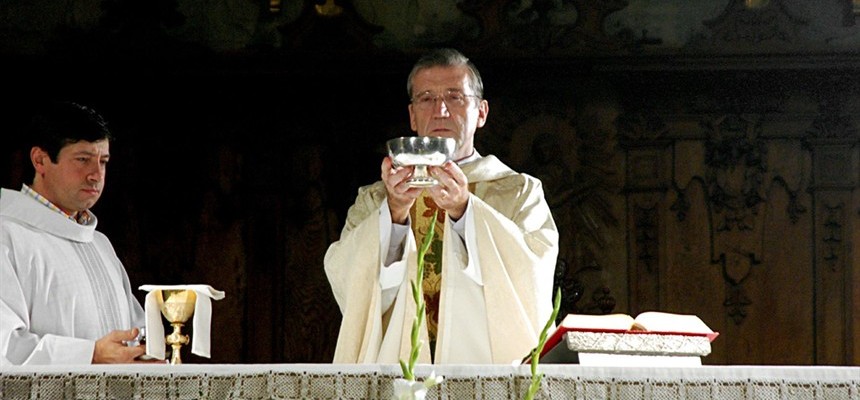
Photo By: Flickr/Vladimer Shioshvili
There are three Feasts that conclude the Easter season in the Church. The first is Pentecost Sunday, which celebrates the coming of the Holy Spirit and the birth of the Church. The folllo0wing Sunday we celebrate the Blessed Trinity. The final Sunday is Corpus Christi, or "Body of Christ" and it has a double meaning that we honor.
The first meaning, of course, is to celebrate the Holy Eucharist. Each week at Mass as we are handed the Host by either the Priest or the Server we hear these words, "The Body of Christ" to which we respond "Amen". A little side story here: As I described in my personal story that began my writings here, I had not been to Mass in over 45 years except for the occasional funeral or wedding. I had forgotten that reply, so when the Priest would hand me the Eucharist I'd respond like any good Evangelical Christian would..."Thank you, brother!" Father Ronnie here in Canlaon didn't think anything of it, but when I was at Saint Patrick's in Kokomo, IN for Easter I responded like that and the Priest looked at me and said "Amen?" and then "Are you Catholic?" I never forgot the response again. LOL
As Catholics there is a special meaning to those words and that response. We are being told and we are agreeing that the Host and the wine (if received) is literally the Body and Blood of our Lord Jesus Christ. The Church teaches that the Presence of the Lord is in the elements of Communion. This is called "transubstantiation" (nice long theological word) and I will expand on that shortly.
One more thought on Corpus Christi as it pertains to you and me as believers. The Bible refers to us in many terms and one of them is "The Body of Christ". The Apostle Paul specifically uses that phrase in 1 Corinthians 12 where he says that we are the Body of Christ and have different functions within that Body just like the various parts of our human body. He also uses it in Ephesians and other letters. We are many individuals with different abilities and different personalities but in Christ we are one in the unity of the Holy Spirit.
The Scriptural Basis for the Eucharist
The issue always arises as to why Protestants cannot receive Communion in the Catholic Church and Catholics likewise in Protestant churches. Words can be the same but have completely different meanings in application. The reason is simple: there is a big difference in the meaning. To the Protestant the bread and wine are merely symbols used to commemorate Christ’s sacrifice on the Cross for our sins. However, to the Catholic they are much, much more than that. We believe that the bread and the wine literally become, in substance if not in physical properties, the Body and Blood of the Lord Jesus Christ. Hence the term “trans (across) substantiation (substance)” As the prophet Amos said, “Can two walk together except they be agreed?”
The Scriptural basis lies first of all in the Last Supper. At the conclusion of what would, in God’s eyes, be the final Passover meal, the Lord took bread, blessed it and gave it to the Apostles. Then He did the same with the cup (an additional cup to the seven normally part of the Paschal Meal). What He said each time is vitally important to understanding the Catholic doctrine on this matter.
This IS…
The events of the Last Supper are recorded in each of the Synoptic Gospels (Matthew 26, Mark 14 and Luke 22). We’ll focus on Matthew 26:26-30. As the Lord blessed the bread He said, “…this IS my Body” and as He blessed the cup He said, “…this IS the blood of my New Covenant”. He didn’t say “This represents My Body” or “This represents My Blood”. The word used there is the Greek word “esti” and it doesn’t mean “symbolizes” but just what the word sounds like “IS”. The Apostle Paul reiterates these exact words in 1 Corinthians 11:23-26.
That the Lord viewed this as much more than merely symbolic can be seen in His words to the Apostles in John 6:53-58. He tells the disciples in no uncertain terms that unless they eat His Flesh and drink His Blood they have no part in Him. No part in the “Lamb of God that takes away the sins of the world”? That sounds much more serious than a mere symbol.
That the Apostle Paul considered it much more than a symbol is obvious as well. He told the Corinthians that if someone eats the bread or drinks the cup “unworthily” then “they are guilty of the Body and Blood of the Lord”. Historically, the Church has always taught the Eucharist. This can be seen in the writings of the Ante Nicene Father, the disciples of the Apostles who continued exactly what they were taught by their mentors.
In fact, the Eucharistic real Presence of the Lord was consistently taught and believed in Christendom up until the Protestant Reformation. It’s only in the rebellion against the Church established and preserved by the Lord that the meaning was changed. This shouldn’t be a surprise since we read in John’s gospel that those who heard Him said that it was a hard saying and John says that many walked away from Christ because of it. Those who are faithful to the Apostolic Succession that reaches all the way back to the Cross don’t walk away but still honor it and receive in the same understanding as the Lord’s Own Words…this IS His Body and this IS His blood.
Recommended Stories
About the Author
I was a Cradle Catholic from the time that I was born through my teen years. I slowly moved away from the Church and as a young adult I became an Evangelical Christian. I spent nearly 40 years in various types of ministry as a teacher, preacher, pastor or evangelist. But my main area of expertise was Apologetics…what we believe and why we believe it. I am a graduate of Central Christian College of the Bible in Moberly, MO with a Bachelor of Science in Biblical Studies. In November of 2014 I retired to the Philippines, where my wife Rose is from. We live in the mountains of Negros Oriental in the small town of Canlaon City with our many brothers and sisters, nephews and nieces (to whom I am “Daddy Mike”).
Nine years ago I reverted to the Catholic Church. I have try to write articles which inform, instruct and equip our Catholic brothers and sisters while avoiding using jargon. I have also sought to defend the Faith with our several Protestant visitors in as kind a way as possible
My archive here, which now contains nearly 80 articles, is located at http://www.catholic365.com/author/mike-bugal/
I may also be contacted via email at mbugal@yahoo.com