On the Metamorphosis of Love: An Analysis of Plato's Influence on Byzantine Christianity on Love

The Papacy


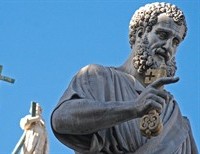
Photo By: Flickr/Bill Evitts
In this article, I will focus on the important topic of the Papacy which will include: Biblical proof of the Papacy, as well as other writings before 300 AD that show evidence that the Early Christians believed in the Papacy (the Supremacy of Peter).
I will be using New American Bible (NABRE), Good News Translation (GNT) (GNT is not a Catholic Bible) and KJV to show the parallelism of the verses between translations. Also, for commentary used during the description of the most important verses I will use an exponent number after the word e.g. Book [0] that will indicate to which verses I am speaking about, or about any other source of information I am using.
Biblical Proof of the Papacy
The most importance verse that reflects the doctrine of the Papacy of the Church is, of course, the verses from the Gospel of St. Matthew:
St. Matthew 16:16-19
NABRE
“Simon Peter said in reply, “You are the Messiah, the Son of the living God. Jesus said to him in reply, “Blessed are you, Simon son of Jonah. For flesh and blood has not revealed this to you, but my heavenly Father. And so I say to you, you are Peter, and upon this rock I will build my church, and the gates of the netherworld shall not prevail against it. l I will give you the keys to the kingdom of heaven. Whatever you bind on earth shall be bound in heaven, and whatever you loose on earth shall be loosed in heaven.”
GNT
Simon Peter answered, “You are the Messiah, the Son of the living God.” “Good for you, Simon son of John!” answered Jesus. “For this truth did not come to you from any human being, but it was given to you directly by my Father in heaven. And so I tell you, Peter: you are a rock, and on this rock foundation I will build my church, and not even death will ever be able to overcome it. I will give you the keys of the Kingdom of heaven; what you prohibit on earth will be prohibited in heaven, and what you permit on earth will be permitted in heaven.” Then Jesus ordered his disciples not to tell anyone that he was the Messiah.
KJV
And Simon Peter answered and said, Thou art the Christ, the Son of the living God. And Jesus answered and said unto him, Blessed art thou, Simon Barjona: for flesh and blood hath not revealed it unto thee, but my Father which is in heaven. And I say also unto thee, That thou art Peter, and upon this rock I will build my church; and the gates of hell shall not prevail against it. And I will give unto thee the keys of the kingdom of heaven: and whatsoever thou shalt bind on earth shall be bound in heaven: and whatsoever thou shalt loose on earth shall be loosed in heaven.
The name Peter comes from the Aramaic word Kepa, which is the only way to say rock in Aramaic. In Greek, the word Kepa translates into the word Kephas, which is the name by which Peter is called in the Pauline letters [1]. This shows that Peter’s functions consist in being the witness of Christ, the Son of the living God, and in being the Vicar of Christ [2]. In the verses above we clearly can read that not even the gates of Hades (death or Hell depending on the translation you are using) will prevail against the Church, which indicates that the Church will never die, and not even the demons at hell can destroy it because it was created by Christ. The image of the keys comes from the Old Testament [3]. The word keys is a reference to power as it allows to open the door of a house, which allows people to walk into the house. Therefore what Peter bounds in the Church here in Earth, it will be bound in heaven as well, and of course the Apostolic Succession shows that gifts given by the Holy Spirit can be passed down [4].
St. John 21:15-18
NABRE
When they had finished breakfast, Jesus said to Simon Peter, “Simon, son of John, do you love me more than these?”* He said to him, “Yes, Lord, you know that I love you.” He said to him, “Feed my lambs.” He then said to him a second time, “Simon, son of John, do you love me?” He said to him, “Yes, Lord, you know that I love you.” He said to him, “Tend my sheep. He said to him the third time, “Simon, son of John, do you love me?” Peter was distressed that he had said to him a third time, “Do you love me?” and he said to him, “Lord, you know everything; you know that I love you.” [Jesus] said to him, “Feed my sheep. Amen, amen, I say to you, when you were younger, you used to dress yourself and go where you wanted; but when you grow old, you will stretch out your hands, and someone else will dress you and lead you where you do not want to go.”
GNT
After they had eaten, Jesus said to Simon Peter, “Simon son of John, do you love me more than these others do?” “Yes, Lord,” he answered, “you know that I love you,” Jesus said to him, “Take care of my lambs.” A second time Jesus said to him, “Simon son of John, do you love me?” “Yes, Lord,” he answered, “you know that I love you,” Jesus said to him, “Take care of my sheep.” A third time Jesus said, “Simon son of John, do you love me?” Peter became sad because Jesus asked him the third time, “Do you love me?” and so he said to him, “Lord, you know everything; you know that I love you!” Jesus said to him, “Take care of my sheep. I am telling you the truth: when you were young, you used to get ready and go anywhere you wanted to; but when you are old, you will stretch out your hands and someone else will tie you up and take you where you don't want to go.” 19 (In saying this, Jesus was indicating the way in which Peter would die and bring glory to God.) Then Jesus said to him, “Follow me!”
KJV
So when they had dined, Jesus saith to Simon Peter, Simon, son of Jonas, lovest thou me more than these? He saith unto him, Yea, Lord; thou knowest that I love thee. He saith unto him, Feed my lambs. He saith to him again the second time, Simon, son of Jonas, lovest thou me? He saith unto him, Yea, Lord; thou knowest that I love thee. He saith unto him, Feed my sheep. He saith unto him the third time, Simon, son of Jonas, lovest thou me? Peter was grieved because he said unto him the third time, Lovest thou me? And he said unto him, Lord, thou knowest all things; thou knowest that I love thee. Jesus saith unto him, Feed my sheep. Verily, verily, I say unto thee, When thou wast young, thou girdest thyself, and walkedst whither thou wouldest: but when thou shalt be old, thou shalt stretch forth thy hands, and another shall gird thee, and carry thee whither thou wouldest not.
In these verses written down by John , in the words we can see that after Jesus' resurrection, he yet reminds Peter again of his (Peter’s) mission, as he is going to go to the world to feed the sheep. This is an important reminder of what the Papacy represents, as he as the head of the Bishops (the earthly representation of Christ) it is here to feed the sheep, and given them love as well. Peter received the mission to tend the sheep.
Peter is the first Apostle to cure someone in the name of Christ [5] as he cured the crippled beggar while walking to the Temple with John. It is important to say that Peter said “In the name of Jesus Christ the Nazareth, walk” which indicates Peter is working through Christ’s Grace as an intercessor (intercession can also be seen in Revelations 5:8).
Early Christian’s beliefs on the Papacy
- St. Ignatius of Antioch, 110 AD, Epistle to the Smyrnaeans
“See that you all follow the bishop, even as Jesus Christ does the Father, and the presbytery as you would the apostles; and reverence the deacons, as being the institution of God. Let no man do anything connected with the Church without the bishop. Let that be deemed a proper Eucharist, which is [administered] either by the bishop or by one to whom he has entrusted it. Wherever the bishop shall appear, there let the multitude [of the people] also be; even as, wherever Jesus Christ is, there is the Catholic Church. It is not lawful without the bishop either to baptize or to celebrate a love-feast; but whatsoever he shall approve of, that is also pleasing to God, so that everything that is done may be secure and valid. Moreover, it is in accordance with reason that we should return to soberness [of conduct], and, while yet we have an opportunity, exercise repentance towards God. It is well to reverence both God and the bishop. He who honours the bishop has been honoured by God; he who does anything without the knowledge of the bishop, does [in reality] serve the devil. Let all things, then, abound to you through grace, for you are worthy. You have refreshed me in all things, and Jesus Christ [shall refresh] you. You have loved me when absent as well as when present. May God recompense you, for whose sake, while you endure all things, you shall attain unto Him.”
- Tatian the Syrian, 170 AD, The Diatesseron
"Simon Cephas answered and said, ‘You are the Messiah, the Son of the living God.’ Jesus answered and said unto him, ‘Blessed are you, Simon, son of Jonah: flesh and blood has not revealed it unto thee, but my Father which is in heaven. And I say unto thee also, that you are Cephas, and on this rock will I build my Church; and the gates of hades shall not prevail against it".
- Tertullian, 220 AD, Modesty
“[T]he Lord said to Peter, ‘On this rock I will build my Church, I have given you the keys of the kingdom of heaven [and] whatever you shall have bound or loosed on earth will be bound or loosed in heaven’ [Matt. 16:18–19]. . . . What kind of man are you, subverting and changing what was the manifest intent of the Lord when he conferred this personally upon Peter? Upon you, he says, I will build my Church; and I will give to you the keys"”
- Clement, 221 AD, The Letter of Clement to James
"Be it known to you, my lord, that Simon [Peter], who, for the sake of the true faith, and the most sure foundation of his doctrine, was set apart to be the foundation of the Church, and for this end was by Jesus himself, with his truthful mouth, named Peter"
- St. Cyprian of Carthage, 251 AD, The Unity of the Catholic Church IV
"The Lord says to Peter: ‘I say to you,’ he says, ‘that you are Peter, and upon this rock I will build my Church, and the gates of hell will not overcome it. And to you I will give the keys of the kingdom of heaven . . . ’ [Matt. 16:18–19]. On him [Peter] he builds the Church, and to him he gives the command to feed the sheep [John 21:17], and although he assigns a like power to all the apostles, yet he founded a single chair [cathedra], and he established by his own authority a source and an intrinsic reason for that unity. Indeed, the others were that also which Peter was [i.e., apostles], but a primacy is given to Peter, whereby it is made clear that there is but one Church and one chair. . . . If someone does not hold fast to this unity of Peter, can he imagine that he still holds the faith? If he [should] desert the chair of Peter upon whom the Church was built, can he still be confident that he is in the Church?"
Notes:
[1] 1 Corinthians 1:12; 3, 22; 9:5; 15:4; Galatians 1:18.
[2] Vicar comes from the Latin word ‘vicarious’ which the origin the notion of the word is “earthly representative of God or Christ”. In French the word vicaoire also means deputy, which connects to the Church’s doctrine as Jesus is the representative of Christ (The Pope is not over Christ). The word Vicarious comes from the word vicis which means succession or position.
[3] The image of the keys are drawn from Isaiah 22:15-25.
[4] 1 Timothy 1:6; 4:14.
[5]Acts of the Apostles 3:1-10.
Additional Note: However I have seen lately that some non-Catholics siblings have left some comments about “Catholics having false doctrines” and if this continue, I personally will address those questions in my blog (catholicwindow.blogspot.com) as well as in Catholic365.com. I will address the questions with more importance but shorter answers in my blog, as I can set my own publishing dates, so if you brothers and sisters are interested in reading about my answers, I invite all of you to start reading my blog. Updates, however, will most likely happen Saturdays, and they will include one to two articles per week.
Recommended Stories
About the Author
My name is Sergio Garibay. I am a young Catholic who enjoys reading and writing Catholic Political Theory & Theology. I consider myself a Neo-Platonic Christian with a large emphasis on The Cappadocians Fathers as well Communio Theologians and Existential Thomism. I have a Bachelors in Economics & a minor in Political Science and I'm currently discerning the priesthood. I am enrolled in the Angelic Confraternity and have a high desire towards interfaith analysis on eschatology. My favorite Catholic figures are Metropolitan Andrej Septyc’kyj, Kyr Josyf Slipyj, Pope Benedict XVI, Fr Hans Urs von Balthasar, Fr Henri de Lubac SJ, Jacques Maritain, Étienne Gilson, St Ignatius of Loyola & St Thomas Aquinas. I welcome each of you to join me in a conservation about the Catholic Faith.
My podcast: https://linktr.ee/CatholicPortal
My Instagram: https://www.instagram.com/Catholic_Portal/
My Twitter: https://twitter.com/Catholic_Portal?s=09
My Facebook group: https://www.facebook.com/groups/christiantrad/?ref=share