Thou Art Peter

Sabbath: Should we worship on Saturday or Sunday?


Photo By: Flickr/Josh
While talking about the day we worship God is important to keep something in mind. The Jews desired to make Saturday the Sabbath as it was the day God rested according to Genesis. The word Sabbath is from the Hebrew word SHABÀT, meaning ‘cessation,’ or ‘time of rest.’ The day chosen for the Sabbath is a day of rest dedicated to Lord, meaning we would offer our prayers in this day celebrating something great, such the Day God rested after the creation of the World.
Why Sunday and not Saturday?
Then if the Sabbath is the time to celebrate something great then why aren’t we celebrating the day God rested? Well, this is because Christians comprehend the fulfillment of the whole meaning. We have the New Covenant and through this we are now able to enter heaven, and in a Sunday morning our Lord resurrected and opened the gates of heaven, “I was dead and look -- I am alive for ever and ever, and I hold the keys of death and of Hades” (Revelation 1:18). He resurrected in a Sunday, “that he was buried; that he was raised on the third day in accordance with the scriptures” (1 Corinthians 15:4). He went to Sheol to bring also the good news to those who were waiting for the gates of the Kingdom to be open. This then becomes the most important celebration of all Christians and all history because, until this momen,t the faithful ones were unable to enter heaven. This day was marked as the new beginning.
So does the Bible says to worship on Sunday?
Absolutely, it does.
*Acts 20:6-7 “We sailed from Philippi after the feast of Unleavened Bread and rejoined them five days later in Troas, where we spent a week. On the first day of the week when we gathered to break bread, Paul spoke to them because he was going to leave on the next day, and he kept on speaking until midnight.”
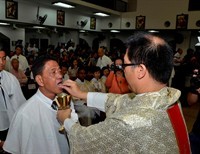
Breaking bread is a referring to the Eucharistic that can be seen in Matthew 26:26-28.
*1 Corinthians 16:2 “On the first day of the week each of you should set aside and save whatever one can afford so that collections will not be going on when I come.”
The first day of the week in Sunday without any other thought. It is important to say [we] Catholics follow the Lunar and Solar Calendars just like the Jews do, so our days start when the sun is down and many times our festival days changed based on the lunar calendar.
*Colossians 2:16-17 “Let no one, then, pass judgment on you in matters of food and drink or with regard to a festival or new moon or Sabbath. These are shadows of things to come; the reality belongs to Christ.”
Here you can see that Paul us talking about not letting other judging you because you do thing different in the festival days, the new moon days or during the Sabbath, this is a clear that is saying “we are different from the Jews”.
*Revelation 1:10 “I was caught up in spirit on the Lord’s day and heard behind me a voice as loud as a trumpet,”
The Lord’s day: Sunday. As loud as a trumpet: the imagery is derived from the theophany at Sinai (Ex 19:16, 19; cf. Heb 12:19 and the trumpet in other eschatological settings in Is 27:13; Jl 2:1; Mt 24:31; 1 Cor 15:52; 1 Thes 4:16).
So how would I answer each of these verses that talk about the Sabbath?
–Mark 2:27 “Then he said to them, “The Sabbath was made for man, not man for the sabbath.”
This is a reaffirmation of the divine intent of the Sabbath to benefit Israel as contrasted with the restrictive Pharisaic tradition added to the law. Ig is important to follow this with Mark 2:28 that says “That is why the Son of Man is lord even of the Sabbath.” The Son of Man is lord even of the Sabbath: Mark’s comment on the theological meaning of the incident is to benefit his Christian readers. It is important to also remember that in the Old Testament it talks about exceptions to following the Sabbath; This based on Mark 2:25-26 when Jesus defends the action of his disciples on the basis of 1 Sm 21:2–7 in which an exception is made to the regulation of Lv 24:9 because of the extreme hunger of David and his men. According to 1 Samuel, the priest who gave the bread to David was Ahimelech, father of Abiathar.
–Hebrews 4:9 “Therefore, a Sabbath rest still remains for the people of God.”
This verse is addressing a problem that Paul answers. The problem was that some Christians (Gentiles and Jews) stopped having a day of rest, so he told them, you must have a day for the Lord. A day of cessation and a day to worship the Lord.
–Luke 23:55-56 “The women who had come from Galilee with him followed behind, and when they had seen the tomb and the way in which his body was laid in it, they returned and prepared spices and perfumed oils. Then they rested on the Sabbath according to the commandment.”
The women helping with the burial with Jesus are correct in resting in the Sabbath, as the resurrection hasn’t occurred yet, at this point of the Bible, so they didn’t know any other day to worship at this moment.
–Acts 13:14 “They continued on from Perga and reached Antioch in Pisidia. On the sabbath, they entered (into) the synagogue and took their seats.”
It is important to see that Paul is with Jews is this moment and not Christians. The Bible also says in Acts 18:4, “Every Sabbath, he entered into discussions in the synagogue, attempting to convince both Jews and Greeks.” This means Paul went to the Synagogues to convince Jews and Greeks that Jesus was the Messiah. Paul wasn’t a Jewish priest nor a Rabbi, and for him to reach and the public was also not allowed, as many saw this as breaking the Sabbath. Furthermore, this can be seen in Acts 16:13, “On the Sabbath we went outside the city gate along the river where we thought there would be a place of prayer. We sat and spoke with the women who had gathered there.” Paul and a companion were trying to find places where people met to worship on the Sabbath to spread the good news of the Lord.
Meanwhile, it is also important to analyze Exodus 20:8-11 and Leviticus 23:3, which speak of saving one day for God, both of them says six days should be off work. It is important to say this because while we still reserve six days, we still have a day of rest.
Is there evidence outside the Bible about Christian worshipping on Sunday?
Yes, there is. This evidence comes from epistles (or letters) of other apostles.
*"But every Lord’s day . . . gather yourselves together and break bread, and give thanksgiving after having confessed your transgressions, that your sacrifice may be pure. But let no one that is at variance with his fellow come together with you, until they are reconciled, that your sacrifice may not be profaned" (Didache 14 [A.D. 70]).
Note: Didache means the teachings of the twelve Apostles, and it is one of the earliest documents in the world that assure us what the Apostles were teaching to others.
* "We keep the eighth day [Sunday] with joyfulness, the day also on which Jesus rose again from the dead" (Letter of Barnabas 15:6–8 [A.D. 74]).
Note: This letter was by the Apostle Barnabas who is mention in the Bible in the following verses: Acts4:10, 4:36, 9:27, 11:22, 11:30, 12:25, 13:2, 13:50, 14:12, 14:14, 14:20, 15:39, 1 Cor. 9:6, Galatians 2:1... this shows Barnabas was an Apostle and his writings should be study.
* "[T]hose who were brought up in the ancient order of things [i.e. Jews] have come to the possession of a new hope, no longer observing the Sabbath, but living in the observance of the Lord’s day, on which also our life has sprung up again by him and by his death" (Letter to the Magnesians 8 [A.D. 110]).
* "[W]e too would observe the fleshly circumcision, and the Sabbaths, and in short all the feasts, if we did not know for what reason they were enjoined [on] you—namely, on account of your transgressions and the hardness of your heart. . . . [H]ow is it, Trypho, that we would not observe those rites which do not harm us—I speak of fleshly circumcision and Sabbaths and feasts?... God enjoined you to keep the Sabbath, and imposed on you other precepts for a sign, as I have already said, on account of your unrighteousness and that of your fathers . . ." (Dialogue with Trypho the Jew 18, 21 [A.D. 155]).
* "But Sunday is the day on which we all hold our common assembly, because it is the first day on which God, having wrought a change in the darkness and matter, made the world; and Jesus Christ our Savior on the same day rose from the dead" (First Apology 67 [A.D. 155]).
* "[L]et him who contends that the Sabbath is still to be observed as a balm of salvation, and circumcision on the eighth day . . . teach us that, for the time past, righteous men kept the Sabbath or practiced circumcision, and were thus rendered ‘friends of God.’ For if circumcision purges a man, since God made Adam uncircumcised, why did he not circumcise him, even after his sinning, if circumcision purges? . . . Therefore, since God originated Adam uncircumcised and unobservant of the Sabbath, consequently his offspring also, Abel, offering him sacrifices, uncircumcised and unobservant of the Sabbath, was by him [God] commanded [Gen. 4:1–7, Heb. 11:4]. . . . Noah also, uncircumcised—yes, and unobservant of the Sabbath—God freed from the deluge. For Enoch too, most righteous man, uncircumcised and unobservant of the Sabbath, he translated from this world, who did not first taste death in order that, being a candidate for eternal life, he might show us that we also may, without the burden of the law of Moses, please God" (An Answer to the Jews 2 [A.D. 203]).
* The apostles further appointed: On the first day of the week let there be service, and the reading of the holy scriptures, and the oblation [sacrifice of the Mass], because on the first day of the week [i.e., Sunday] our Lord rose from the place of the dead, and on the first day of the week he arose upon the world, and on the first day of the week he ascended up to heaven, and on the first day of the week he will appear at last with the angels of heaven" (Didascalia 2 [A.D. 225]).
*Note: I chose to use these writings from the Early Christians (aka Early Church Fathers) to show Protestants that Emperor Constantine did not change the day of Worship. All writings here are prior Constantine birth and the legalization of Christianity in the Roman Empire. I should add that I ask my Protestants siblings to study the faith and not to remain in schism as the Apostle Barnabas also wrote: "You shall judge righteously. You shall not make a schism, but you shall pacify those that contend by bringing them together. You shall confess your sins. You shall not go to prayer with an evil conscience. This is the way of light". I also want to apologize from the grammatical errors in my articles, as my biography says English is not my first language. I learned English around five years ago, so I please ask you to have patience with me, and pray for me as well.
Recommended Stories
About the Author
My name is Sergio Garibay. I am a young Catholic who enjoys reading and writing Catholic Political Theory & Theology. I consider myself a Neo-Platonic Christian with a large emphasis on The Cappadocians Fathers as well Communio Theologians and Existential Thomism. I have a Bachelors in Economics & a minor in Political Science and I'm currently discerning the priesthood. I am enrolled in the Angelic Confraternity and have a high desire towards interfaith analysis on eschatology. My favorite Catholic figures are Metropolitan Andrej Septyc’kyj, Kyr Josyf Slipyj, Pope Benedict XVI, Fr Hans Urs von Balthasar, Fr Henri de Lubac SJ, Jacques Maritain, Étienne Gilson, St Ignatius of Loyola & St Thomas Aquinas. I welcome each of you to join me in a conservation about the Catholic Faith.
My podcast: https://linktr.ee/CatholicPortal
My Instagram: https://www.instagram.com/Catholic_Portal/
My Twitter: https://twitter.com/Catholic_Portal?s=09
My Facebook group: https://www.facebook.com/groups/christiantrad/?ref=share