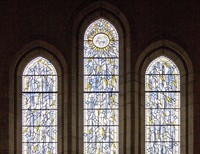
Can Heretics Go to Heaven?

The Protestant Dilemma


Photo By: Flickr/John Ragai
1 John 4 "We are writing this to you so that our joy may be complete"
The Protestant denominations began with Luther and his 95 theses on October 31, 1517 when they were posted in the doors of the Church of the Castle of Wittenberg. Martin Luther was excommunicated in 1520 by Pope Leo X.
The Problem with Protestantism?
The Faith is something that we carry in our hearts. From the Virgin Mary who is the first Christian, continuing with Peter 'the Rock', to today's layman, Bishops and the Pontiff, the Catholic Church is a faith that survived the attacks of Nero, the conquering of Hagia Sophia, and even more. The main problem with Protestantism is that they are in schism. There is also not just one protestant church, according to the Pew Research Center there is around 60 denominations of Protestantism in the United States (http://www.pewforum.org/religious-landscape-study/). Each denomination tends to disagree with each other, for example some denominations allow women to be Pastors, while others only allow men, then who is right?
The Faith is like a tree, it grows strong and tall pointing to the sky. On the other hand, Protestantism is like branches who fell from the tree. Yes, the branches were part of the tree, and many can considered as still being part of the tree, however a branch can never be equal to the tree.
The Eucharistic and Protestantism:
John: 6:49-53 “Your fathers ate manna in the desert and they are dead; but this is the bread which comes down from heaven, so that a person may eat it and not die. I am the living bread which has come down from heaven. Anyone who eats this bread will live forever; and the bread that I shall give is my flesh, for the life of the world.' Then the Jews started arguing among themselves, 'How can this man give us his flesh to eat?' Jesus replied to them: In all truth I tell you, if you do not eat the flesh of the Son of man and drink his blood, you have no life in you.”
The Protestant world tends to (at least most denominations) say that the Eucharist isn't the actual Flesh and Blood of Christ, by doing this they fail to realize the beauty of the Eucharist. The Eucharist is the actual Body and Flesh of Christ, according to the Bible (Matthew 26:26-28 and 1 Corinthians 10:16-21). Unfortunately, the Protestant Church fails to see the beauty of the Apostolic Succession and the beauty of the Eucharist.
Which Protestant denomination then helps me to obtain a closer relationship with Christ?
John 3:5 "Jesus answered, “Amen, amen, I say to you, no one can enter the kingdom of God without being born of water and Spirit."
We must be transformed into the faith. We are caterpillars waiting to become butterflies; we must regenerate ourselves into full-time Christians (Commentary on Romans 2:29; Col. 2:11–12). With the existence (at least) of 60 denominations of Protestantism in America, then which denomination can help us grow closer to God? Of course, I know all denominations use the Bible, but as it was the initial idea of Wycliffe (one of the initial 'fathers' of Protestantism) that each person must have their own interpretation of the Bible, then by this idea each person's relationship with Christ will depend on what each one likes, wants and needs, rather than what Jesus wants from you. Each denomination also makes their own rules about marriage (such as the cases about those denominations that accept divorce, gay marriage, etc), also in the case of those denominations idea of who can be a pastor (females and males vs males only), or even more those who have prophets. To seek a relationship with Christ, we must look for what Christ wants from us, and this can only be if the Church is the Pillar of the Truth (referring to the Magisterium of the Catholic Church with Commentary on 1 Timothy 3:15). All of us can't pass the Biology class if each of us has our own interpretation of the book. Wouldn't be a better idea to listen to the author(s), the students (disciples) of the authors, and read the commentary those students make (Letter of Barnabas is one of the first, if not the first commentary on the Bible. It dates back to 70 AD. Many claim that Barnabas was the theological teacher of St. Paul).
Then please I want you guys to answer this questions:
Does God want a unified and Universal Church or a divided family?
Why are you Catholic? or (Why aren't you Catholic?)
GOD BLESS
Recommended Stories
About the Author
My name is Sergio Garibay. I am a young Catholic who enjoys reading and writing Catholic Political Theory & Theology. I consider myself a Neo-Platonic Christian with a large emphasis on The Cappadocians Fathers as well Communio Theologians and Existential Thomism. I have a Bachelors in Economics & a minor in Political Science and I'm currently discerning the priesthood. I am enrolled in the Angelic Confraternity and have a high desire towards interfaith analysis on eschatology. My favorite Catholic figures are Metropolitan Andrej Septyc’kyj, Kyr Josyf Slipyj, Pope Benedict XVI, Fr Hans Urs von Balthasar, Fr Henri de Lubac SJ, Jacques Maritain, Étienne Gilson, St Ignatius of Loyola & St Thomas Aquinas. I welcome each of you to join me in a conservation about the Catholic Faith.
My podcast: https://linktr.ee/CatholicPortal
My Instagram: https://www.instagram.com/Catholic_Portal/
My Twitter: https://twitter.com/Catholic_Portal?s=09
My Facebook group: https://www.facebook.com/groups/christiantrad/?ref=share