Mary, Mary, I'm Contrary: How to Own Your Spiritual Mother

Is the Pope Catholic ?


Photo By: Flickr/Waiting For The Word-Holy Spirit
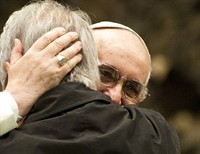
Pope Francis has left many Catholics scratching their heads (with some even pounding their fists). Commentators have desperately tried to tie him to the liberal or conservative camp only to hear a week later that Francis has made one more of his trademark ”off the cuff” comments which seems to blow their latest theories to smithereens. Speaker and author Father Dwight Longnecker says that the key to understanding the Holy Father is that he is at heart an Evangelical, Charismatic Catholic.
I have put in a link to what I believe is a very insightful article from Catholic World Report by Father Longnecker. If you are trying to make sense of this papacy, I believe it's worth a read! Find it here:
Pope Francis’s obvious respect and fraternal outreach to Charismatics and Evangelicals is disturbing to many. It seems so … un-Catholic. Yet both St. John Paul II and Pope Emeritus Benedict XVI have readily extended their friendship and support to both charismatic renewal and to evangelicals. While the present pontificate has had an uptick in dialogue with these two groups, the conversation has been continuing for some time. For example, Dr. Billy Graham preached in the cathedral in Krakow in 1981, where St. John Paul II met with him the first of many times. The two also exchanged correspondence. Pope Emeritus Benedict also reached out to these groups. In 1998, some years before his election, the then Cardinal Ratzinger stated:
“We must not allow the establishment of a blasé enlightenment that immediately brands the zeal of those seized by the Holy Spirit and their naïve faith in God’s Word with the anathema of fundamentalism, allowing only a faith for which the ifs, ands, and buts become more important than the substance of what is believed.”
Pope Francis has met openly with American televangelists Kenneth Copeland, James Robison, and Joel Osteen. In July of 2014, he visited a local Pentecostal church in Caserta, Italy, asking forgiveness for harm done to them by Catholics.
Does this kind of relationship and openness undermine Catholic identity? What might the outcomes be? Such entreaties certainly have the power to change our perceptions, but the Early Church, as described in the Acts of the Apostles, was evangelical, charismatic AND catholic. I will point to just one passage, from Acts 2:22 and following:
“This is the Jesus God has raised up, and we are his witnesses. Exalted at God's right hand, he first received the promised Holy Spirit from the Father, then poured this Spirit out on us. ... Therefore let the whole house of Israel know beyond any doubt that God has made both Lord and Messiah this Jesus whom you crucified. When they heard this, they were deeply shaken. They asked Peter and the other apostles, "What are we to do brothers?" You must reform and be baptized, each one of you in the name of Jesus Christ, that your sins may be forgiven: then you will receive the gift of the Holy Spirit. ...They devoted themselves to the apostles’ instruction and the communal life, to the breaking of the bread and the prayers. A reverent fear overtook them all, for many wonders and signs were performed by the apostles.”
The above passage presents the kerygma, or preaching of the basic message of repentance and life in Jesus Christ. There is also mention of the reception of the Holy Spirit and signs and wonders done in the Name of Jesus. All of this activity leads to a common life and the “apostles’ instructions and the breaking of the bread”' or Eucharist. A serious reading of the Acts of the Apostles will show this pattern repeated throughout. We do not see one or another of these facets competing with each other. No. Instead, we see all three elements happening simultaneously and with great effect!
The hostility that Christians presently face in the 21st century is not unlike that faced by the Early Church. Perhaps, through the papacy of Francis, the Holy Spirit is bringing these three elements—evangelical, charismatic, and catholic—separated for so long, back together, so that we may once again look like that early church from Acts 2. This Church, fearlessly proclaiming the Gospel under the power of the Holy Spirit, with the leadership of Peter, dramatically altered the course of history, and built Western Civilization. Perhaps this new common ground among all Christians is the soil of the New Springtime we’ve been waiting for.
Recommended Stories
About the Author
Gwen is a displaced Canuck, a cradle Catholic of good Irish stock, and a student of theology who somehow ended up becoming a social worker. She left all that glamour behind to marry a Southern boy and home school their two children. Involved in youth ministry since college, Gwen is passionate about renewal in the Catholic Church by the power of the Holy Spirit, and the clear, uncompromising proclamation of the Good News to Catholics and non-Catholics alike. A newbie blogger, you can check out her latest post at: fireontheearth.net
More Stories By :