What I Learned from the Early Christians about Spiritual Growth, Part 6: We need the Truth

What I Learned from the Early Christians about Spiritual Growth, Part 4: We Need to Struggle

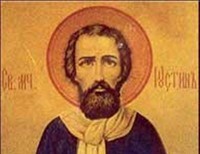
Photo By: Flickr/Ted-Icon: St. Irenaeus of Lyons
A few years ago I was leading my seminarians through a study of the ascetic teachings of some of the Early Church Fathers. One of the seminarians raised his hand and asked a question born of a mixture of deep perplexity, hope, and fear. “According to the Fathers,” he asked, “Is there any way for a person to grow that doesn’t involve suffering?” This is a question any of us would ask, hoping for a positive answer.
A question like this deserves a reflective answer, and I spent a minute in thought, and finally, as gently as I could, I told the class that I have never encountered a single orthodox writer of the early Church that thought there was an easy way to spiritual growth. The reason for this is simple, but not easy to accept. For the Fathers and Mothers of the early Church, to grow spiritually is to become more like Christ, and since Christ suffered, if we are to become like Him it can only be through sharing in His suffering in some way. That suffering can come about through external circumstances such as a serious illness or a persecution, or it could come about through a deliberate choice on the part of the believer, for example through a decision to fast on a certain day, or to give one’s possessions away to the poor. But either way, the early Christian writers were virtually unanimous that some form of self-sacrifice was essential to spiritual growth.
Irenaeus of Lyons, for example, made a distinction between the image and likeness of God. We are born in the image of God, Irenaeus taught, but we must grow into His likeness, and that is the purpose of this life. His understanding of what it meant to grow into the likeness of Christ was shaped by event about which he was personally aware. Irenaeus was a presbyter of the newly formed Church of Lyons. When he was in Rome on Church business, the Church of Lyons experienced a savage persecution, in which several prominent members of the congregation were executed in a brutal fashion. One of the martyrs was an elderly woman named Blandina. She was tied to a stake and burned to death, a horrible death. But it is recorded that at the moment of her death, she stretched forth her arms and the people witnessing her death saw not Blandina, but Christ Himself, suspended on His cross.[1]
When Irenaeus returned to Lyons, his first task was to write back to Rome about what happened, so he was intimately acquainted with the suffering of people he knew well. He also must have been intimately aware of the miracle that had occurred to Blandina, which resulted in the conversion of many people. So he well understood the role that suffering plays in the sanctification of souls. He also grasped the essential fact; the miracle that occurred to Blandina points to a deeper mystery. It is through suffering, as painful as it may be, that we are slowly molded into the image of Christ, until we can bear that image to the world and reveal it to all who have eyes to see.
Even given this understanding, there are still objections that come to mind. What about the sufferings of infants, who might die before having a chance to grow spiritually or physically at all? Or, more basically, why go through this messy process at all? If God had wanted us to be like His Son, why not just create us fully formed in His image and likeness? There are of course no real answers to these questions that can fully satisfy us, but following on Ireaneus’s thought, and borrowing from the Gospel of John, we can see the outline of a possible answer. Irenaeus wrote, famously, that “The glory of God is man fully alive.”[2] This statement of Irenaeus’s has been much misunderstood, and has to be unpacked carefully, against the background of the understanding of glory found in John’s Gospel. In the Gospel of John, it becomes clear to the reader that the moment of Jesus’ glorification is the moment He is raised up on the Cross..[3]
This understanding of what it means to be ‘glorified’ takes some of the sting out of the thought of human suffering. Suffering becomes the means by which we fulfill our highest destiny as human beings, to shine forth not our own glory, but the glory of our Risen Lord, in whose image we were created and into whose likeness we are being transformed.
This does not mean that we should seek out random pain as a means of spiritual growth. There are, however, two things we can do that will ensure that the suffering we endure will redound to the greater glory of God:
- When suffering unavoidably comes to us, as it comes to all humans sooner or later, we can consciously unite our suffering to that of Christ, for the good of those people for whom we are praying.
- We can and should also engage in conscious acts of self denial for a spiritual purpose. For example, periodic fasting, which is recommended throughout the Bible, can help us to understand what it means to be poor, and hungry, and constantly in need of enough food to live.
Suffering is not pleasant for any of us. Unfortunately, it seems to be an unavoidable part of human life. We will experience pain, sorrow, struggles in this life. We can suffer pointlessly, or we can use our suffering as a means of growing closer to the Lord and fulfilling our ultimate destination, to be fully formed in the image and likeness of our loving Father through His Son Jesus Christ.
When we do so, we should constantly remember the words of our Lord before His own time of suffering: “In this world you will have tribulations; but be of good cheer, for I have overcome the world.”[4]
[1] Eusebius of Caesarea, Church History, 5.1-4.
[2] Irenaeus of Lyons, Against Heresies, 4.20.7.
[3] See John12:22-24 for one of many passages in which Jesus explicitly makes this connection.
[4] John 16:33
Recommended Stories
About the Author
Carl Sommer holds an M.A. in historical theology from Aquinas Institute of Theology in St. Louis, Missouri. He has one published book, "We Look for a Kingdom: The Everyday Lives of the Early Christians." He has fifteen years’ experience as a religious educator in St. Louis, where he lives with his wife and two daughters. He is currently Adjunct Professor of Church History at Kenrick Glennon Seminary in Saint Louis.
More Stories By :