Putting Pope Francis in Perspective

Justice Without Rights?

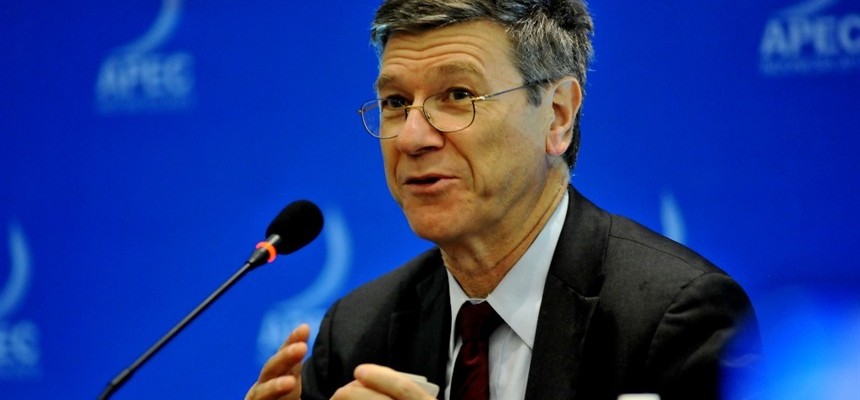
Photo By: Flickr/APEC 2013
In “A Call to Virtue,” an article in the May 18, 2015 issue of the Jesuit magazine America, Vatican adviser Jeffrey Sachs made the following statement:
Pope Francis has declared that the joy of the Gospel can help the world to overcome the globalization of indifference to others. Undoubtedly, he will bring this message when he visits the United States. But when he does, he will face a society in thrall to a different idea — that of the unalienable rights to life, liberty and the pursuit of happiness. The urgent core of Francis’ message, which is the message of Jesus’ Sermon on the Mount, challenges this American idea by proclaiming that the path to happiness lies not solely or mainly through the defense of rights but through the exercise of virtues, most notably justice and charity.
With all due respect to so eminent an authority, it is difficult to understand how anyone could have made such a contradictory statement — until we realize that Dr. Sachs, as is clear from the website of Sustainable Solutions Development Network (http://unsdsn.org/), of which he is a director, is a pro-abortion Keynesian economist. As such, Dr. Sachs’s understanding of the natural law is antithetical to the political theory and philosophy that underpins both Catholic social teaching and the United States government.
In Catholic thought, every human being is created equal and therefore has the same capacity to acquire and develop virtue, virtue being the habit of doing good, just as vice is the habit of doing evil. This is, in fact, what defines us as human beings, created in God’s image and likeness. The difference between God and man is that God is infinitely perfect, and thus His capacity to acquire and develop virtue is completely and fully realized. Humanity, however, is infinitely perfectible, and can spend eternity becoming ever more perfect in virtue.
Acquiring and developing virtue is, in the philosophy of Aristotle and Aquinas, the path to true happiness: “the pursuit of happiness.” The four virtues natural to humanity, i.e., for which every human being has the built-in capacity to acquire and develop, are prudence, temperance, fortitude, and, above all, justice.
In addition, in Thomist philosophy, the super-natural (“above nature”) virtues are faith, hope, and, above all, charity. These are distinguished from the natural virtues because God infuses every human being with the capacity to acquire and develop faith, hope, and charity as a gift, not as part of inherent human nature.
The supernatural virtues of faith, hope, and charity therefore do not — and cannot — replace or substitute for the natural virtues. Instead, the role of the supernatural virtues is to fulfill or complete the natural virtues by building on them, not eliminating them. As Pope John Paul I reminded us in a Wednesday allocution during his brief pontificate, “Charity is the soul of justice” — a reiteration of Jesus’s declaration in Matt. 5:18 that He came to fulfill the law, not abolish it. As Pope Pius XI explained, “no vicarious charity can substitute for justice which is due as an obligation and is wrongfully denied.” (Quadragesimo Anno, § 137.)
This is where Dr. Sachs makes his error. He claims that “the path to happiness lies not solely or mainly through the defense of rights but through the exercise of virtues, most notably justice and charity.”
The problem with what Dr. Sachs says is that it makes no sense. He seems to demand justice and charity while at the same time rejecting natural rights. Charity, however, is not true charity unless the demands of justice have been met — and justice is not true justice if it is not based on fundamental human rights. What Dr. Sachs demands, then, is charity without justice, and justice without rights. This would leave us with . . . what?
Certainly not with the means of attaining a life of virtue, what Aristotle called “the good life.”
To explain, of the key triad of natural rights, that is, life, liberty, and property, life is the most important, but property is the most immediate. This is because property is the primary means by which we sustain life and liberty. As Daniel Webster pointed out, “Power naturally and necessarily follows property” . . . and it is impossible to exercise even your rights to life and liberty unless you have the power to do so.
That’s because “property” is not the thing owned, but the inherent, natural (unalienable) right to be an owner built into every human being, and the socially determined and limited rights that define how an owner may use what he owns, that is, how he exercises his rights.
In general, under the traditional, legal definition of private property, no one may exercise property in any way that harms others, including infringing on the rights of others. For example, no one may deprive others of the “fruits of ownership,” i.e., what is due an owner because he is an owner, such as the income attributed to the thing owned and control over it. As Louis Kelso put it, “Property, in everyday life, is the right of control.”
Acts of justice, that is, the exercise of rights, can therefore in no way be separated from justice. A presumed virtue not supported by acts of the virtue is nothing more than self-delusion, a vague feeling that might make someone feel good, but has no substance. As St. James noted in his Epistle,
What doth it profit, my brethren, if a man say he hath faith, but have not works? can that faith save him? If a brother or sister be naked and in lack of daily food, and one of you say unto them, Go in peace, be ye warmed and filled; and yet ye give them not the things needful to the body; what doth it profit? Even so faith, if it have not works, is dead in itself. Yea, a man will say, Thou hast faith, and I have works: show me thy faith apart from thy works, and I by my works will show thee my faith. (2:14-18)
The bottom line is that you cannot have true justice without rights, any more than you can have true rights without justice. Similarly, unless justice has been materially fulfilled, you cannot have charity, any more than you can have true justice without charity. As Pope Benedict XVI explained in § 6 of Caritas in Veritate,
First of all, justice. Ubi societas, ibi ius: every society draws up its own system of justice. Charity goes beyond justice, because to love is to give, to offer what is “mine” to the other; but it never lacks justice, which prompts us to give the other what is “his”, what is due to him by reason of his being or his acting. I cannot “give” what is mine to the other, without first giving him what pertains to him in justice. If we love others with charity, then first of all we are just towards them. Not only is justice not extraneous to charity, not only is it not an alternative or parallel path to charity: justice is inseparable from charity, and intrinsic to it. Justice is the primary way of charity or, in Paul VI's words, “the minimum measure” of it, an integral part of the love “in deed and in truth” (1 Jn 3:18), to which Saint John exhorts us. On the one hand, charity demands justice: recognition and respect for the legitimate rights of individuals and peoples. It strives to build the earthly city according to law and justice. On the other hand, charity transcends justice and completes it in the logic of giving and forgiving. The earthly city is promoted not merely by relationships of rights and duties, but to an even greater and more fundamental extent by relationships of gratuitousness, mercy and communion. Charity always manifests God's love in human relationships as well, it gives theological and salvific value to all commitment for justice in the world.
In light of this, how could Dr. Sachs think that fundamental human rights are not, somehow, essential to human existence? By being a pro-abortion Keynesian, someone philosophically committed to the abolition of life, liberty, and property as natural rights.
In the Keynesian view, the State is all-powerful, a manifestation of the “Mortall God” of the totalitarian philosopher Thomas Hobbes, that rules on Earth as the Immortal God rules in Heaven. If anything stands in the way of the State achieving a goal or objective, Keynes believed that the State has the power simply to define that thing out of existence through the exercise of absolute power, whether life, liberty, property, or anything else. As Keynes declared in the opening passages of A Treatise on Money (1930), the book he intended as his magnum opus,
[The State] claims the right to determine and declare what thing corresponds to the name, and to vary its declaration from time to time — when, that is to say, it claims the right to re-edit the dictionary. This right is claimed by all modern States and has been so claimed for some four thousand years at least.
Thus, to a Keynesian, sovereignty and rights do not reside in “We, the People,” but in the State. In this view, rights are not something inherent in the human person, but are doled out by the State as those in power find useful or expedient. People become “mere creatures of the State,” and are only permitted to exist if the State or those who control the State find it convenient.
State-worship is not only contrary to the founding principles of the United States, however, it contradicts the essence of Catholic social teaching: respect for the dignity of the human person. Human dignity, in fact, requires nothing less than recognition and protection of fundamental human rights. Chief among these are the natural rights of life, liberty, and property essential to the pursuit of happiness — rights that Dr. Sachs would set aside.
Dr. Sachs’s position is therefore unacceptable not only to Catholics, but to Americans of all beliefs, or none. Natural, unalienable rights are the basis of both Catholic social teaching and the U.S. government. Francesco Cardinal Satolli, first Apostolic Delegate to the United States, made this clear. As he urged Americans, “Go forward on the road of progress, bearing in one hand the book of Christian truth — Christ’s gospel — and in the other the Constitution of the United States.”
Recommended Stories
About the Author
Michael D. Greaney is Director of Research for the Center for Economic and Social Justice, an all-volunteer, interfaith think tank in Arlington, Virginia, U.S.A. A Certified Public Accountant, Mr. Greaney received his BBA from the University of Notre Dame and his MBA from the University of Evansville, Indiana. He has audited for the American Red Cross, Georgetown University Medical Center, and the Federal Election Commission. An expert in binary banking and monetary theory and the Kelso-Adler-Ferree theories of economic and social justice, Mr. Greaney has published numerous articles on monetary and economic history, theory, and practice. He has also edited the novels of John Henry Cardinal Newman and Monsignor Robert Hugh Benson, as well as Archbishop Fulton J. Sheen’s “long lost” classic, Freedom Under God (1940), William Cobbett’s The Emigrant’s Guide (1829), and William Thomas Thornton’s A Plea for Peasant Proprietors (1846, 1871). He contributed to Curing World Poverty (1994) and Capital Homesteading for Every Citizen (2004). His most recent publication is “The Business Cycle: A Kelsonian Analysis” in the March 2015 issue of The American Journal of Economics and Sociology. His books include In Defense of Human Dignity (2008),Supporting Life (2010), The Restoration of Property (2012), So Much Generosity (2013), and The Political Animal (2014).
CESJ website: http://www.cesj.org/
Personal blog: http://just3rdway.blogspot.com/
Twitter account: @JustOwnership FaceBook page: https://www.facebook.com/michael.d.greaney
Publications websites:
The Mainstream Novels of Robert Hugh Benson
The Fiction of John Henry Newman
Science Fiction and Fantasy from Universal Values Media
Distributist Books and Media
Benson Unabridged
A Plea for Peasant Proprietors