Someone to Teach

Why can't a Catholic take communion in a Protestant church?

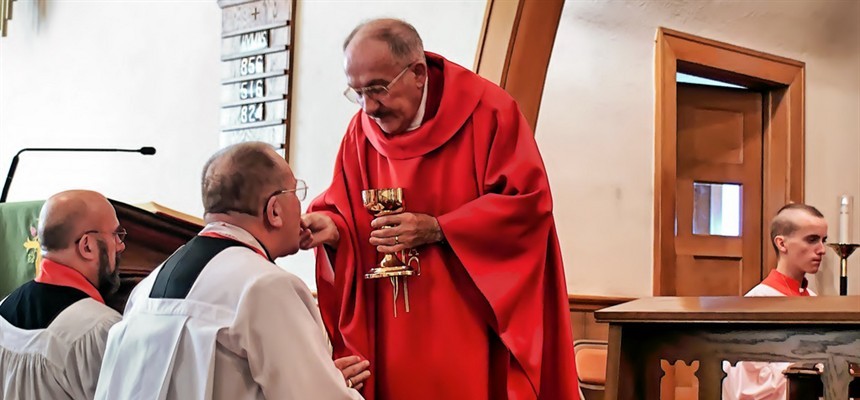
Photo By: Flickr/Jeanette Runyon
I hear it a lot, this question of why a Catholic can’t take the communion in a Protestant service, especially from Catholics whose extended families include a lot of Protestant relatives. Most often, there is appeal to neighborliness. “I know it’s not the same, but is just seems rude not to go up and receive, especially when they ask me to..”
Neighborliness is indeed a virtue, and it’s good to want to find common ground with our separated brethren. Even so, some things cannot be compromised for the sake of social interaction and this is one of them.
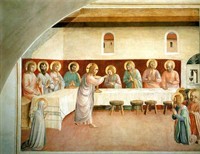
It helps to remember that communion was one of the first dividing controversies in Jesus’ ministry. Jesus taught that we must eat His flesh and drink His blood to have life in us; a good many of his followers abandoned Him because the teaching was too hard. Jesus then asked the twelve whether they, too, would leave, and Peter gave his famous reply: Lord, to whom would we go? You have the words of eternal life. Peter did not understand the teaching either, at that point, but he was willing to trust and follow Jesus, not be distracted by alternatives.The Eucharist as Catholics believe it has always been a source of division in the world—as is Jesus Himself. That should be no particular surprise, given that the Eucharist makes Jesus truly present--really here--in the consecrated Host and Precious Blood.
For the first 1500 years of the Church there was one understanding of what the Eucharist is. Read the Church Fathers and you will see: though they did not have the term “transubstantiation.” They believed that Christ is really and truly present in the Eucharist and they took great pains to keep those who did not believe or were in a state of sin from receiving it. The Reformation changed all that (and even the early Reformers did not agree among themselves about the meaning of the Eucharist). What Protestants receive in their communion services and what Catholics receive in the Eucharist are different and should not be confused
The simple reason why Catholics may not receive communion in Protestant worship is that intercommunion with Protestants is forbidden both by the Catechism and Canon law. Canon 844 states: “Catholic ministers may licitly administer the sacraments to Catholic members of the Christian faithful only and, likewise, the latter may licitly receive the sacraments only from Catholic ministers. Whenever necessity requires or a genuine spiritual advantage commends it, and provided the danger of error or indifferentism is avoided, Christ’s faithful for whom it is physically or morally impossible to approach a Catholic minister, may lawfully receive the sacraments of penance, the Eucharist and anointing of the sick from non-Catholic ministers in whose Churches these sacraments are valid.” CCC 1400 states, " Ecclesial communities derived from the Reformation and separated from the Catholic Church, "have not preserved the proper reality of the Eucharistic mystery in its fullness, especially because of the absence of the sacrament of Holy Orders." It is for this reason that, for the Catholic Church, Eucharistic intercommunion with these communities is not possible.
Now, let’s look a little deeper to understand why this is so important:
(1) Christ established ONE Church and it subsists in its fullness in the Catholic faith. The Catholic Church views these denominations (Presbyterian. Lutheran, Episcopal, non-denominational) as ecclesial bodies of believers (Christians by virtue of baptism) that do not yet possess the fullness of the faith. Most importantly, they do not have sacraments, apart from marriage and baptism, because they do not have a valid priesthood and priesthood is required for the remaining five sacraments, including the Eucharist. Hence, their communion is, for Catholics, invalid as well as illicit (it isn’t what it is supposed to be and it is forbidden for Catholics to receive it.) Moreover, to do so knowing full well that the Church forbids it may constitute a grave (mortal) sin, that of blasphemy.
(2) The Church teaches one can be in communion with only one body at a time. If you are in communion with the Catholic Church, then you cannot be in communion with another ecclesial body. Remember that as a Catholic you are “married” to Jesus through His Church and one of the sacraments of that marriage is the Eucharist. Taking communion in another Church is like cheating on your spouse.
(3) When you accept communion you are saying I believe (that’s what the Amen! Is, after all) to all that that particular body is teaching–that’s what communion is. Catholics do not believe what these other ecclesial bodies believe about Holy Communion and should not receive communion there, no matter what well meaning Protestants say to encourage Catholic participation in communion services. A Catholic looks to the Catholic Church to teach him, form his conscience and guide his life.
Protestants view things very differently from Catholic and although their advice (“It’s Jesus’ table, you are welcome! It’s wrong of your church to say you can’t come.”) may be well meaning, it is not the advice of the Church. Protestants may be willing to have Catholics at their table, but Catholics are not free to participate. And even Protestant groups that claim to believe in the Real Presence do not have a valid priesthood (not even the Episcopalians) and that is a requirement for a valid Eucharist. Only the Catholic, some Old Catholic, and Orthodox Churches have a valid, sacramental Eucharist.
(4) When a Catholic receives communion in another ecclesial setting, it causes scandal. As much as we wish for Christian unity, we do not yet have it and making it appear that we do sends as signal to those with weak faith or unformed faith that it doesn’t matter where one worships. Is receiving a cracker and some grape juice (or even bread and wine) the same as receiving Our Lord, Body and Blood, Soul and Divinity? Not to recognize that is the indifferentism that Canon law warns against.
The Eucharist is the source, summit and focus of our life in Christ, it communicates Christ to us and is a real and powerful means of grace. It should not be confused with the communion services of other traditions. When Catholics participate in a Protestant communion, not believing what Protestants believe, but making an outward show that they do, they give at least outward honor that should go to God in the Eucharist to the mere creatures of bread and wine. Given that God in the person of Jesus established communion in the Church ( and told us what it is and means in the Bread of Life discourse, which ends with John 6:54). Catholics owe it to God to participate in that sacrament as, and only as, He sets out. And He sets that out through the Church to whom the sacrament was given: not a Protestant communion service, but the Catholic mass.
(5) The Episcopal denominations (there are now many schisms within that body) pose a particular problem because the liturgy closely resembles the form of Catholic liturgy, and many of them will argue that they, too, believe in the Real Presence. In fact, some of the more orthodox Episcopal congregations are much more reverent towards their communion than Catholics are towards the Eucharist.
Regardless of what latter day Episcopalians might think, the schismatics who broke away from the Catholic Church and formed the Anglican Communion did not intend their communion as a Real Presence. (You can see this reflected in Article 28 of the The 39 Articles; for what it is worth, Article 22 rejects Purgatory and Article 25 rejects all the sacraments except baptism and holy communion.) Further, Pope Leo XIII in Apostolicae Curae ruled very clearly that holy orders in the Episcopal ecclesial bodies are not valid. So: No priesthood, no valid Eucharist, no discussion, not matter how much it resembles Catholic worship on the surface and no matter how much Episcopalians argue to the contrary. For Catholics the matter is settled.
(6) Canon law does provide for exceptions for receiving communion outside the Catholic Church, but only for those churches with a valid priesthood and in cases of necessity. “Being neighborly” at a Protestant wedding doesn’t constitute necessity and Protestants do not have a valid priesthood.
We are called as Catholics to witness to our faith. That means living visibly as Catholics, showing the world the grace that flows through Christ’s Church. Among those graces is the privilege of receiving Jesus Christ, body and blood, soul and divinity, at Mass; Jesus giving Himself to us completely without reserve in the Eucharist.
It is sometimes good in the interests of friendship and ecumenism to attend Protestant services with our loved ones. But what a witness it would be to refrain from communion and explain, gently and lovingly, why! The answer cannot be “because the mean old Church tells me I can’t.” We have the fullness of the faith. We have Jesus truly and substantially present at every Mass, and we receive Him into our very selves. We have the full complement of sacraments as channels to the grace we need in everyday life to help us on our journey to heaven. Isn’t the neighborly thing to do to invite others to come, learn about our faith so that they too can make a declaration of faith and share the feast with us rather than the other way around?
Recommended Stories
About the Author
Barbara Golder is a convert to the Catholic faith, a physician and attorney, wife, mother and writer. Her breakout novel, Dying for Revenge, a Catholic murder mystery, is available on Amazon and Amazon kindle. She is the Director of Adult Faith Formation and Evangelization at the Basilica of Sts. Peter and Paul in Chattanooga, Tennessee. She lives in Lookout Mountain, Tennessee with two dogs, two cats and her husband of 40+ years, with whom she collaborates on a variety of photoessays and projects. View them at www.thesehandsbmj.com andwww.stephengolderphotography.com.