
The Beginner's Introduction to Mass
Attending Catholic Mass for the first time can be rather confusing and foreign for the non-Catholic. In looking around the internet for a good introduction to the Mass to show my non-Catholic friends and family, most of the ones I find seem to be too in depth and complicated for one who has never been to Mass to really understand. So I decided to write an simple introduction to the Mass for the first-time attendee. I do not intend to go into details, or even go through every single thing that happens at Mass. Instead, I am simply going to go through the basic format of the Sunday Mass. Hopefully it will give the non-Catholic enough information to be at ease and not feel out of place while attending.
One of the first things that one will notice in attending Mass are the different body postures that Catholics take. Catholics stand, sit, and kneel. Each of these postures have meaning:
Standing at Mass is a sign of showing reverence and honor to God. One of the main places where we stand is during prayers to God.
Sitting during Scripture readings and the homily is a posture that shows that we are to be attentive to what is being said to us.
And finally, kneeling is a sign of humbleness and submission before God. Catholics kneel during the Eucharistic Prayer, which is when the bread and wine become the Real Presence of Christ (more on that later).
Now, on to the actual Mass. Mass is divided into two main parts, which are the Liturgy of Word and the Liturgy of the Eucharist. Let's discuss the Liturgy of the Word.
LITURGY OF THE WORD
Mass begins with the opening procession, a time of remembering where we have sinned, and we ask God for His mercy. After this there are four Scripture readings. One reading from the Old Testament, one from the Psalms (which is usually sung), one from a New Testament letter, and finally a reading from one of the four Gospels. After this, the priest (or sometimes a deacon) will expound upon the readings in a homily, and show us how we can apply them to our lives. When the homily is over we pray the Nicene Creed, offer prayers to God as a community, and collect an offering.
If this sounds too complicated, let me put it in more simple terms. During the Liturgy of the Word, Catholics hear the Word of God proclaimed, and we respond to that Word by professing our faith, praying for others, and giving to others. To make it even simpler:
We hear!
We respond!
LITURGY OF THE EUCHARIS
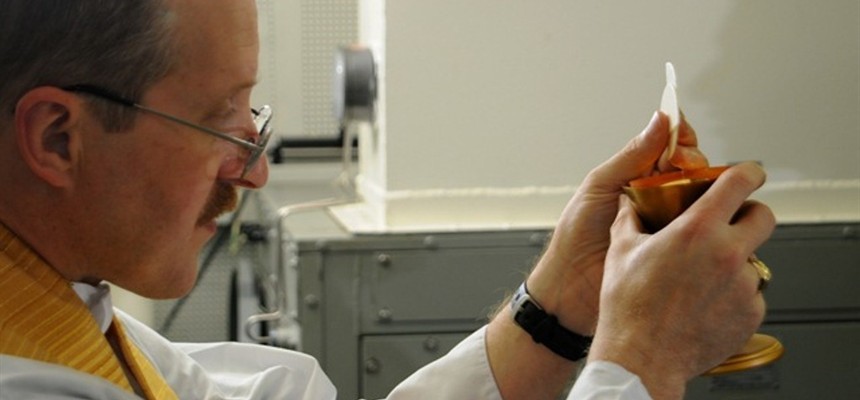
The second part of Mass is called the Liturgy of the Eucharist, and it begins when members of the congregation (who represent all who are present) bring to the priest the bread and wine that will be used for Communion. There is a prayer of thanksgiving for what God has provided, followed by the Eucharistic Prayer (one will recognize when this starts because everyone will kneel). It is during the Eucharistic Prayer that Catholics believe that the bread and wine become the actual Body and Blood of Christ. After the Eucharistic Prayer we pray the Lord's Prayer together and exchange a sign of peace (which is usually a handshake in our culture) that reminds us to make peace with our brothers and sisters before we approach Communion.
After the sign of peace is Communion, which is when Catholics go forward to receive the Body and Blood of Christ. One important thing needs to be mentioned here is that the Catholic Church practices what is called closed communion, which means that only Catholics who are in full communion with the Catholic Church should receive Communion. This is because Catholics see the sharing of the Eucharist as a sign of the unity of faith. After Communion is the closing hymn and procession, and it is over.
To sum up Mass in a nutshell, in the Liturgy of the Word Jesus feeds us with His Word, and we respond in faith and action. And in the Liturgy of the Eucharist Jesus feeds us with Himself, and we then go forth into the world, nourished with Christ and His Word, to share the Gospel with others.
As I wrote in the beginning, my intent isn't to go into all of the details of the Mass, or even explain every single thing that happens at Mass. In fact, even after reading this, I'm sure that the non-Catholic would still have a lot of questions after attending Mass for the first time, and that is great! But hopefully I have given enough information that the first time attendee will not feel confused about what is going on around them. Hope to see you at Mass Sunday!
Recommended Stories
Matt Warner and his wife converted to the Catholic Church in the year 2000 from the Southern Baptist denomination. Before his conversion he was a licensed Baptist minister where he served in several ministry roles from supply preaching, youth ministry, to being an associate pastor of a small congregation in west-central Missouri in the mid-1990's. Matt and his wife are now Catholic youth ministers in the Clinton, Missouri area where they are seeking to build and support rural parish youth ministry.
Feel free to connect with Matt at:
https://www.facebook.com/matthew.david.warner
https://www.linkedin.com/pub/matthew-warner/85/b54/629



