Living Catholic in a Secular World

What Lent and the Triduum Can Teach Us


Photo by Allef Vinicius on Unsplash
Many years ago, I head someone say that the Triduum was their favorite liturgical season. I didn’t appreciate this. Honestly, I saw it as that person’s attempt to appear pious and righteous at the expense of honesty.
For me at that time, Lent and the Triduum were seasons of darkness. They interfered with the spring that was attempting to bud in my consciousness. They made me aware of my weakness. They showed me how little I was willing to suffer. They showed me how utterly lacking my idea of suffering was. Perhaps most significantly, they brought me face to face with my own anxieties as these seasons of suffering ask us to do away with a lot of what we use to hide ourselves from reality.
It felt bad. I didn’t like to feel bad. I hid from it.
In many ways, I just refused to participate in these seasons. I refused to “do Lent.” I knew that I shouldn’t eat meat on Fridays, but I did anyway. I knew that I should have been fasting, but I didn’t. I talked myself out of any need to do penance, instead deciding to focus on “doing good.” I honestly didn’t do much of that either.
I am happy to say that a decade or so later, I have changed my opinion. With all pretense aside, Lent and the Triduum are my favorite liturgical seasons of the year, and they are also my favorite times of the year personally.
Liturgically, these seasons give us so much history, and that history helps us dig deeper into the realities of our rich faith heritage. Why do we not use bells during the consecration on Holy Thursday? Why is Holy Thursday the birthday of the priesthood? Why is there no actual Mass on Good Friday? Why do we have all the readings on Holy Saturday? Why does Lent go beyond 40 days? Why, on certain Fridays on certain years, are we supposed to actually avoid abstaining from meat?
Many outward acts of our faith are symbolic of what is real. They are there to instruct us. The outward manifestations of our faith teach us very real lessons about what is beyond our sight and sometimes our understanding. The more things change during Lent, the more we can see and appreciate our faith throughout the entire year.
My personal experience of Lent has changed over the years apart from the liturgy. Now I know a little bit of why we embrace suffering during this time. Because I have abstained and avoided and given up, I understand just how much our bodies need to be mortified if we are to allow them to work in union with our souls rather than to usurp them or overshadow them.
Life, in general, has taught me that suffering is unavoidable and also that there is no time in life when God can feel quite as close as when we are suffering. Lent shows us why. Despite claims by some that a just God would never allow us to suffer, Lent shows us that suffering is a part of life, and that while God will not remove all suffering from us, he was willing to enter into it himself to sanctify it and to sanctify us. He didn’t take it away; instead he took it on. We know that the God who accompanies us in the hospital room knows suffering because every day at Mass we see him hanging on the cross over the altar.
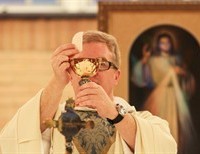
Except when we don’t. When we go to Mass towards the end of Lent and see the hidden Jesus on the cross, we are able to see just how much we need that Jesus who so intimately understands out plight by our side. The lack of a visible Jesus teaches us how much we need the real Jesus, the one present to us in the Eucharist.
Lent isn’t just for the pious. It’s not just for those who completely understand the faith. It’s clearly not for those who have no lacking in any way.
Lent is for those of us who are broken. Those of us who need a Christ who understands. Those of us who need desperately to know that we are not alone.
Lent is for us all.
Easter is glorious. It reminds us of Christ’s victory and of the victory we can achieve in him. But the Triduum… that’s where we come face to face with the reality that God became one of us.
Recommended Stories
About the Author
Amanda Knapp is an overextended but remarkably happy stay at home mother to three little girls, ages 2-6. In life before children, she was a college English instructor, mainly teaching writing. Now that she has kids and limited social contact, she writes to stay sane and to purge all of the doubts that wander through her mind. Amanda received a thoroughly Catholic education from k-undergrad. After a few years floundering in her faith, she, her husband, and her three girls have found their way back home to the Catholic Church, and she enjoys sharing how her faith plays a role in her every day life. She blogs about mothering, life, and faith on her blog, Indisposable Mama as well as on a couple of other sites out there in the big, wide world of the internet.
Blog: www.indisposablemama.com
Facebook: www.facebook.com/IndisposableMama
Twitter: www.twitter.com/IndisposableMom