Looking Into the Sun

A Faithful Friend


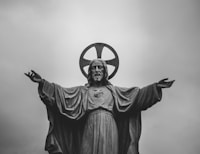
Photo by Grant Whitty on Unsplash
The caretaker of a cemetery noticed a man praying at a particular grave every week. Occasionally he’d put flowers on the grave. The caretaker observed the man for years, and his curiosity finally got the better of him until he one day worked up the courage to ask the man, “Who’s buried here that he should deserve so much of your devotion and love?”
The man replied, “This is the grave of a very dear friend of mine. In the Korean War he volunteered to take my place so that I could stay at home with my wife and children. He was killed in his first battle.” Then with tears in his eyes, the man continued, “Do you blame me for being so grateful to the man who died so that I could live?”
Jesus died so that we could live with Him in heaven for all eternity. Holy Mass isn’t Jesus grave; it’s the sacrifice of Jesus on the cross re-presented on the altar. You should go to Mass faithfully not only because you’re bound under pain of mortal sin to go on Sunday and holy days of obligation, but because you should show Jesus how thankful you are for Him dying for you.
Any Catholic (and any honest Protestant) who reads the Bible regularly will eventually realize that the entire Christian message makes absolutely no sense without the Holy Sacrifice of the Mass. In Matthew 5:17, Jesus said in His Sermon on the Mount, “Do not think that I have come to abolish the law or the Prophets; I have not come to abolish them but to fulfill them.”
Based on what most people know about Christianity—Catholic or Protestant—they give lip service to the notion that Christ merely fulfilled the law and didn’t abrogate it, because the common face of Christianity looks and feels so very different under the New Covenant from the Old Covenant. Fact is, the average Christian doesn’t think Jesus fulfilled anything, but rather replaced the old law with a new set of laws.
Just ask the average Christian—Catholic or Protestant—if they believe Jesus replaced the Old Covenant with the New Covenant and they’ll most likely tell you that He did. But that flies in the face of what He said in the Sermon on the Mount! Indeed, the entire Sermon on the Mount was a set of all new teachings that looked completely different from the old law. So what’s the answer to this dilemma?
It all boils down to worship. The standards set forth in the old law are most certainly much different than this set down by Christ in the new law. The reason for that is because sanctifying grace was introduced into the world the first time since the fall of our first parents. But if we leave it at that we still have no explanation of how Jesus fulfilled the Old Covenant with the New Covenant; it does appear that He merely replaced on with another.
In the Old Testament God established the Old Covenant with the children of Israel through Moses. As a part of that covenant, God told Moses to set aside the tribe of Levi as the priests who would be intercessors for the people by offering various sorts of sacrifices—flesh, grain (including bread), and wine. Each of the various sacrifices were for different things, and those sacrifices could only be offered to God by the Levitical priesthood.
God not only established the various sacrifices, but He went so far as to tell the Israelites how the worship area was to look, the vestments to be worn by the priests, what vessels to use for the sacrifices, and what symbolic decorations were to be used—even specifying what materials were to be used for everything. In other words, God told the children of Israel exactly how He demanded to be worshipped. There was no room for experimentation on the part of the priests, nor was there to be any deviation by the people from the Old Covenant liturgy whatsoever.
The problem with the Old Covenant sacrifices was that they were imperfect. They had no eternal salvific value. The reason for this was because God had not yet fulfilled His promise to send the Messiah into the world. He promised at the fall of our first parents, and many times subsequent to that, He would give us a savior to restore mankind to its original state of friendship with Him.
Jesus was the long-awaited Messiah. He fulfilled the Old Covenant by establishing a new and everlasting covenant. That fulfillment is the Holy Sacrifice of the Mass—the highest form of worship of God, perfecting the imperfect sacrifices of the Old Covenant.
So let’s return to the Protestant view, and (sadly) the view of most Catholics, that Jesus replaced the Old Covenant with the New. As I stated earlier, these people give lip service to what Jesus said in Matthew 5:17, but if you ask them how Jesus fulfilled the Old Covenant they’re mystified. You’ll either get that deer in the headlight look, or they’ll stammer with nonsense while trying to think of a reasonable answer.
The reason Protestants react with foolish babble to the question of how Jesus fulfilled the Old Covenant is simple: they don’t have the Real Presence of Christ in the Holy Eucharist and the Holy Sacrifice of the Mass. The reason that the overwhelming majority of Catholics don’t have an answer to that is because they haven’t been given the fullness of the faith in catechesis for seventy years. But the answer is simple: the imperfect Old Covenant sacrifices established by God the Father for various purposes were perfectly fulfilled by God the Son on Holy Thursday Night in the upper room when He celebrated the very first Mass!
When Jesus established the New Covenant, He didn’t anoint a Moses-type person to be a mediator between Himself and the people, as the Father had done. Rather than establish a mediator, Jesus gave His authority to Peter and his successors—HIS VERY OWN AUTHORITY. So it’s the Catholic Church that speaks to us today about how God demands to be worshipped. And guess what? The Church says exactly how it’s to be done. No experimentation with the liturgy is permitted, the Church tell priests how they’re to vest, the Church says what materials are to be used for the vessels, and she even tells us what the bread for the Holy Eucharist has to be made from. And just as God Himself told the children of Israel exactly how they were to participate in the old liturgies, today the Catholic Church tells us exactly how we should participate in the Holy Sacrifice of the Mass. it’s all spelled out in the General Instruction of the Roman Missal, commonly referred to as the GIRM. It’s easily available. You should get yourself a copy. Of course, more likely than not, you’ll find that the laity (including yourself) aren’t being obedient to God.
Recommended Stories
About the Author
I’m a convert of thirty-plus years. God has used me to make hundreds of converts and reverts, eighty-four of whom are my adult godchildren. I’m a consecrated member of the Marian Catechist Apostolate, under the direction of Raymond Leo Cardinal Burke. I host The Cantankerous Catholic podcast, and I have a weekly column in The Wanderer and Church Militant.
My wife and I live in the Ozark Mountains of Missouri. I’m also a proud veteran of the United States Army and a gold star father. I’m permanently bound to a wheelchair, due to a debilitating stroke. My favorite pastimes are to sit with my wife on the back deck and watch the wildlife, engaging in apologetics, and evangelizing non-Catholics and lapsed Catholics.