Literally unlimited
Sponsored

Catholic365 is sponsored by
Road to Purity




A priest once instructed me on what faith is, through an analogy.
When I go shopping in a grocery store, if I want a can of cream of mushroom soup, I go to the soup aisle, pick out a can labeled "cream of mushroom," and head to the check out. But, how do I know that the can really does have cream of mushroom soup in it? I can't open up the can in the store, verify that it really is cream of mushroom soup, and then buy it. No - I have to have faith in the company that they put the right product in the right can.
Assume a flood came to the grocery store, the priest continued, and all the labels were washed off all the cans of soup. They are now indistinguishable from each other. One might be cream of mushroom, the next chicken noodle. Now, if I really want a can of cream of mushroom soup, I have no way to know.
So, faith is trust. Trust that what we are told is true. For Catholics, the magisterium is the faith taught by priests, bishops, and our Pope. One of the most important tenants of faith is transubstantiation – the real presence of God in the host. The bread – which looks, feels, and tastes like bread – is really Christ’s body. The wine is really Christ’s blood. Those things which we see, feel, and taste are just accidental – it’s God, and we believe it’s God.
Compare that to the bible: It’s easy to believe the bible is the word of God. Believing that doesn’t require me to suspend my belief in what words are.
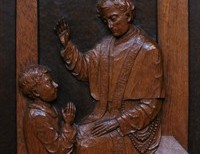
I struggled with transubstantiation for a long time. I even confessed to my priest once. He praised me – saying what a gift it was to have this struggle. Pray on it. Reflect on it. Come to believe how great this is!
I couldn’t do it. I tried. I read. I prayed. I meditated. Nothing. Well, not nothing. But my belief was intellectual. In my head, but not in my heart.
After a time, a new priest was assigned to our parish, and I confessed again my lack of belief. This priest knew my struggle. His penance: “Just, believe.” As in, stop fighting it. Stop thinking about it. Stop intellectualizing it, overanalyzing it, and just believe.
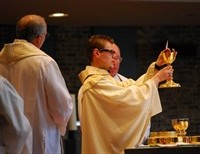
I tried. I may have convinced myself that it was that easy. So, I volunteered to be an EM at mass. On the altar, I was given a cup of the precious blood. I walked down to my assigned spot in front of the congregation, and held the cup out for the first person.
“Blood of Christ.” I said. And instantly, like a snap of someone’s finger, I knew. I was holding the blood of Christ. His blood was in my hands. It was astounding. There’s no other way I can describe the feeling.
But, the Body was another story.
Many years later, I was praying at a funeral mass of a friend. At the start of the service, I closed my eyes, and could see a shimmer on the back of my eye lids. Like the shimmer of a curtain before a Broadway show. As the priest said the opening prayer, I could see the veil parting. Angels were swooping down, to join the mass. I knew if I opened my eyes, I would see the angels there, and I so desperately wanted to.
I opened my eyes – and didn’t see any angels. But, my eyes were not deceiving me. Those angels were still present. Later, during the consecration, the priest held up the host and chalice, and said, “behold, the lamb of God.” I closed my eyes again – and could see Jesus over the altar…holding his heart in his hands. His heart was right where the host was. When I opened my eyes, I could see the host. When I closed my eyes, I saw Jesus’s heart. Open – host. Closed – Jesus.
It wasn’t like Jesus’s heart was surrounding the host. It wasn’t like the host was laying on top of his heart. It was one and the same. The host was his heart, and his heart was the host. The magisterium, what I had been taught for years, was true.
For me, the can of soup has been opened. I know now what’s inside. God is there, in the Eucharist. And part of me understands why the first priest told me it was wonderful to not believe. The search, the wonder, the joy of discovery. That’s gone now, for me.
And that’s o.k. Because, I believe.
The author is an attorney who lives in the Midwest with his wife and children. A cradle-Catholic, he left the Church as a young adult, but came back to the fold and now fully lives his faith.
The author chose this pseudonym as a way to describe his writing, which he hopes will guide him in all his articles, which will in turn lead others to God.