The Truth Will Set You Free
Sponsored

Catholic365 is sponsored by
Road to Purity




Baptized at infancy, Catholics go forward with a natural communal progression through the Sacraments. First Communion is around age 6 or 7, and Catholics are usually confirmed around 12 or 13 years of age. In between these crucial faith experiences, firm catechesis becomes routine in the lives of the young Catholics. But what happens after Confirmation?
I admit, my experience is small to say the least, but according to my limited experience, there is little the Church offers for Catholics after Confirmation. For teenagers, parochial schooling provides the majority of their religious foundation. Of course, Catholics may enroll in RCIA at any point in their journey. Youth programs such as ACT and other youth groups offer further study and spiritual enrichment. Many colleges and universities have Newman Centers for Catholic students, and these centers cater to other local Catholics as well. Theology on Tap and YAM groups provide faith-based fellowship for after college.
However, for these programs to be of any use, they must first be in existence. The sad reality is, many parishes do not have these programs established nor is there a sufficient population to justify running them. According to a Georgetown survey, only 24% of parish members attended Mass weekly in 2014. The demographic least likely to show up? 18-25 year old singles.
My guess is it’s not a lack of population that causes the problem. In my own experience, a good many young adults claim Catholicism as their faith. They just don’t show up on Sunday mornings, Saturday evenings, or to any other kind of church-related event. They’re Catholic – they’re just only Catholic when they have to be, like for Christmas, Ash Wednesday, Palm Sunday, and Easter (CAPE Catholics), or for a marriage or baptism. As a secretary friend of mine put it, “After they’re confirmed, Catholics tend to go and do what they want until they’re married and it’s time to raise their children the same way they were raised.”
As an 18-25 year old single in a Catholic church (and possibly the only current parishioner in that demographic), this distresses me. I would like Catholic peers to hang out with and grow in faith together. I would like a small selection of eligible Catholic mates. I would love to have Catholic influence in every area of my life, particularly the social and relational aspects. It seems that every Catholic young adult I know struggles with similar issues. Unless you’re blessed with a giant parish in a metropolitan area and/or a phenomenal Newman Center, there is little in the way of Catholic life for young adults.
I’m not here to analyze why or how this all came about. That’s in the past and will do no good. Of course, neither does sitting around pointing out a potential problem. I’d like to offer some suggestions to young adults and their parishes to help resolve the issue:
1. Theology on Tap, Active Catholic Teens, and Other Social Groups
If your parish doesn’t have one, start one.
No, really. Do it.
If you’re the 18-25 year old and you wish you had faith-based peers, maybe you’re called to start such a group in your area. Get involved with the high-school aged teens in your parish. Become a youth sponsor and help develop the spiritual lives of those younger than you. This will develop your leadership skills, relationship skills, and it will help you mature in your faith. It may also lead to the need for a group in your age-range as the high school students grow older. If you’re not in that age group, maybe consider starting and leading a group for them.
Never underestimate the power of special interest groups. Right-To-Life rallies, rosary groups, and singles’ groups all provide means of fellowshipping in which many young adults and teenagers would love to partake. The diversity of such groups also introduces them to older members of the parish and allows for them to build relationships with the elderly. Much wisdom can be passed on these friendships as well as much laughter and joy!
2. Reach Out To Colleges
If there’s a local college, reach out to the campuses. Start a Bible study or prayer group on or near campus and advertise on campus for the students. If a few mature and appropriate students stand out, have them start leading groups of their own with local high school students from your parish. The college students will benefit from the responsibilities of leadership, and the high school students get to hang out with someone cool (more or less.) Both this and the above suggestions are great ways to draw young adults into the Church and keep them interested in coming.
3. Timing
Time is a big issue for lots of young adult Catholics. A big problem for many of them is that, while they would love to come to Sunday morning Mass, work and other schedules simply get in the way. See if the parish can manage a Sunday night Mass or emphasize the Saturday evening Mass. A weekday night Mass may also help – especially since many adults, like nurses or firefighters, can’t always have weekends off, as well. If a Mass isn’t acceptable, see the above suggestions and develop some kind of regular meeting that will foster fellowship among young adults.
4. Get Them Involved
When you grow up in a particular church, sometimes it’s hard for older members to recognize that you’ve grown up and are capable of taking on more responsibilities. This results in ‘checking out’ from parish activities. Young adults feel they have much to offer and are capable of more than what they are currently doing, but they don’t fully know exactly what they can offer. What’s the solution? Parishes should reach out to young adults. VBS is coming up? Check with the young adults and high school students to see if a particular night or weekend would work for a set-up and decoration party. Ask them to be a group leader for VBS. Ask them to help cantor during a specific Mass. Got a mission trip coming up? Emphasize the importance of young adults going and being involved; consider the possibility of offering a youth scholarship to help cover fundraising costs. Use their flexibility, energy, and youthfulness to enhance the Kingdom through your parish’s events.
5. Support Events
Alright, so maybe the size of your parish doesn’t allow for young adult groups. That doesn’t mean there aren’t ways to support and garner young adult members! The Franciscan University of Steubenville has annual conferences for young adults and teenagers, such as Encounter. Many dioceses have events such as cursillo or W.A.T.C.H. weekend retreats. Promoting such events provides an outlet for young adults and teenagers to refuel spiritually and connect with like-minded peers.
Maybe it’s just me. Maybe I’m crazy or just haven’t seen enough of the Catholic Church yet. But when I look around, ask my peers and see that many of them have the same issue that I have, I can’t help but wonder if it’s legitimate and, if so, what can be done. Regardless, on the chance that I’m not crazy and maybe your parish has this same struggle, I hope there’s something in here that can help you and your parish!!!
Sarah is an aspiring writer, artist, businesswoman and teacher from Cornfield, USA. Having studied extensively under evangelical mainstream Protestants and growing up as one of them, Sarah felt something was missing in her faith and found her life was lacking the real presence of Christ. She converted to Catholicism in April 2014 to begin a new chapter. A month later, she began another new chapter in her life by graduating from Lincoln Christian University with a degree in business administration and TESOL certification (Teaching English to Speakers of Other Languages.) While new to the faith, Sarah hopes to use her training and understanding of Protestant and Catholic doctrine to open up more dialogue between the faith communities. Currently, having graduated with her Masters of Arts degree in Composition and Rhetoric, she teaches high school English as well as English as a Second Language in rural Illinois. She married her husband in July 2024.
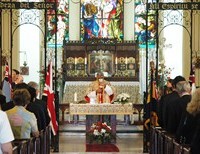
(Photo courtesy of Michael Gowin Photography)