Why I Went to West Webster: a catholic firefighter's experience of a double line-of-duty-death
Sponsored

Catholic365 is sponsored by
Road to Purity



On January 5, 2010, I fought my first fire in the new district. As our apparatus turned off of Broadway, it became apparent that the city snow plows had not been down this road since they made their first pass early that morning – so we were pretty sure that the thin, meandering road we needed to turn onto next was going to be treacherous. Listening to the radio on the approach, I already knew that the first-arriving units were having trouble cracking the closest hydrant they hit… after they had to shovel it out.
Sure enough, we had to inch along into position once we got on the little road (the house on fire being on one side and a cemetery enclosed by a wrought iron gate right up against the street on the other). As I hopped out of the rig and began to suit up, I looked over and noticed the aerial ladder extended above the building, avoiding the power lines, stabilizers extending like wings from each side of the truck to keep it from tipping over. How did they get that thing in here?! I wondered in amazement.
Meanwhile, the lieutenant in charge of our truck checked in with Command. We were assigned to the delta side of the structure – the first side of the house you hit when you start at the front, street-facing alpha side and move around the property counter-clockwise. There were ladders to be thrown up to the windows and tools to be brought out. Then we assisted with stretching additional hose lines. The Red Cross was already set up at a safe distance, assisting the displaced occupants with hot drinks and blankets.
Smoke was puffing out of the eves below the roof, and attack teams were hitting it from the ground Unfortunately, all that did was push fire down the length of the front of the house so that it emerged from the eves on the delta side. Wait! Wasn’t there a team inside on the second floor, advancing to that exact location, expecting to make use of the ladders we had just thrown up against the windows?
A firefighter already had a hose line in his hand knocking the fire back in the direction from which it came. You can’t have fire venting right above the area that your guys are expecting to bail out of. As I was processing this, an officer shouted at me, “BACK HIM UP!”
Instinctively, I dropped to my knees and sat on the hose to fix it in position. That’s how we would do it in the rural district from which I came. “BACK HIM UP!,” came the order again, and I sprang to my feet and got right up behind the man with the hose, taking on all its weight so that he could be free to direct the nozzle where the water was needed.
That was a bitterly cold day. It seemed much colder after the water hit me and when I needed to stand in one place at various times during the operation. I remember thinking that I might prefer to be inside the fire room, itself, where at least I would be warm. But I wasn’t. I was assigned to the outside on the delta side. When the fire was out and the first of our units began to pack up, I was assigned to roll hose.
I had no sensation in my fingers. My third pair of gloves was soaked through. I just knelt on the frozen ground, capturing the 1 ¾ inch, the 2 inch, the 2 ½ inch lengths of hose between my outstretched arms and fists, shrugging my shoulders as the line slowly rolled my way. When I got too tired, I stood up a bit and duck walked my way along, rolling the hose as I went. When I could no longer feel my feet, I knelt back down and did as before.
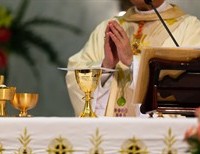
At the end of the Traditional Latin Mass, there is the reading of what is colloquially called, “the Last Gospel.” St. John’s Prologue - Jn 1:1-14. It is read from the left side of the altar – the gospel side – and from a position facing slightly to the left, the North, and only in Latin. As with the Latin version of the Epistle and the Gospel that are read at the time you’d expect them to be read earlier in the Mass, the intended audience of the Last Gospel is not me and it is not you. Vernacular renderings of the readings are for you and I, but not the Latin. The Latin Epistle and Gospel earlier in the Mass are actually intended as part of the Sacrifice that is given to God at the altar. The pronouncement of the Last Gospel, spoken to the North and in the official language of the Roman Church, is intended as something for the World.
One time last year, as I stood up for the Last Gospel and faced forward, I had a clear view of the priest, who was turned a little toward the northbound left, and the altar boy standing directly behind him, backing him up. I attend the Traditional Latin Mass each Sunday, so I have experienced the Last Gospel many times, but this was the first time I made the connection. That voice from the past barked into my ear: BACK HIM UP!
So I did.
In all justice, a World that will not be converted to Christ needs to have Christ preached to it, none the less. Moreover, it cannot be allowed to advance on souls who have taken shelter in the Church or to consume those who want to escape. I must prepare myself to back up the offering of the Mass by supporting the weight of the real Christian Life in my own state and rendering aid to those who can be rescued out of it. Good intentions are a start, but there is a lot at stake. There is God to be glorified, a two thousand year-old patrimony to be preserved, people to be edified, and souls to be saved – most importantly for me, my own. I need to get this right. It’s a good thing that, as with fighting a structure fire, no one is in it alone.
Mark Ingoglio is an emergency responder working in fire, EMS, and emergency management. A graduate of Mt. St. Mary College and originally a teacher of English and then also of high school Latin, he holds a CBIS from the American Academy of Certified Brain Injury Specialists and currently teach adult survivors of brain injury in the sub-acute rehabilitation setting. He is a life-long Catholic and resident of New York State, and a devotee of St. Ignatius and the Jesuit saints, admiring their drive to "go anywhere and do anything" in the service of Christ and His Catholic Church.