Images of God's mercy

A sign that multiplies the blessing

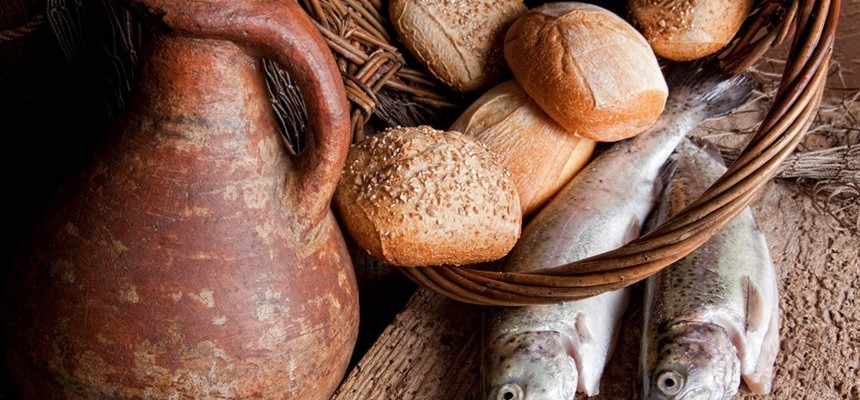
The Sign points to us who Jesus is.
The Gospel story about the multiplication of loaves would bring memories many years ago on trusting the greatest Provider and the power of God’s Word. I was assigned to order food packs to sell during a Catholic Charismatic Assembly which was attended by a thousand participants. It was announced before the event that food would be available at a very affordable price as a fund-raising project for the youth in our parish where I was the president. Towards the end of the event, I noticed that less than half of the ordered food packs were sold, and I have to pay for the remaining if left unsold. I was so anxious and worried. I said to my group: Okay, this is it, we have to divide the excess or give them to a charitable institution and pay the excess. We were so frustrated with the loss. A gentle old lady asked me out of the blue: Boy, so what will happen to this unsold food? I said: Well, we are going to pay for them, with a sad face. She paused a little while and excitedly said: Do not worry, I will pay for everything! I almost dropped to my knees to thank her. She added: Please donate them to the orphanage of the sisters, will you?
The story of the feeding of the five thousand is the only miracle story to be found in all four Gospels. What sets the Gospel of John apart from the synoptic Gospels are the following:
The Gospels would prefer to use the words -dunamis (work of power)-dynamism, teras, (wonder), or semeion (sign) signpost, which is important, but it is the destination according to a Biblical scholar Tom Wright. Example: going to the restaurant, we look at the menu, not to eat it. If a miracle is a sign, we go beyond the sign itself. It is not where it leads us, but to whom does it point to us. Thus, the miracle brings us a deeper revelation of God in the person of Jesus. The Gospel of John has several chapters (1-12) that center on signs.
This Gospel does not mention Jesus’ compassion for the crowds, who are like sheep without a shepherd as mentioned in last Sunday’s Gospel as well as in Matthew’s account. Rather, this story has to do with faith in Jesus rather than His compassion.
In the Synoptics, the disciples distribute the bread, but in this Gospel, Jesus, acting as the host, does it, “Then Jesus took the loaves, gave thanks, and distributed them to those who were reclining, and also as much of the fish as they wanted.”
This (Jesus) said to test (peirozon) (Philip)” (v. 6a). Peirazon can mean “to examine” or “to tempt.” The examiner hopes that the student will pass the test, while the tempter hopes that the student will fail. Jesus is an examiner here hoping to find in Philip a man of faith. “For he himself knew what he would do” (v. 6b). Jesus has a plan in mind. He is not asking Philip a question to initiate a brainstorming session to solve a difficult problem. He is probing Philip to learn the depth of his faith. (Sermon Writer).
If ever Passover is mentioned, it’s a signal of great importance. The Gospel tells of three Passovers. The first Passover was in Jerusalem. Jesus cleansed the temple, while in the Synoptic Gospels (Matthew, Mark, and Luke), cleansing takes place near the end of Jesus’ ministry. And this Gospel reports it as taking place immediately after the first of Jesus’s signs, a miracle of abundance, the making of wine from water at the wedding feast in Cana of Galilee.
Now, at Jesus’ second Passover, the feeding of the five thousand (6:1-14), a miracle like unto God’s gift of manna in the wilderness—a linkage that Jesus will make clear in the Bread of Life discourse (6:22-40) that follows the feeding of the five thousand. Note that the Gospel has two stories. Aside from the feeding of the five thousand, Jesus walking in the water reminisces the crossing of the red sea to escape from the Egyptian army and while the Israelites were fed by God with manna.
And the third Passover which requires eight chapters for its narrative (11:55-19:42) will include the events on Jesus’ crucifixion and death. Thus, the Old Testament Passover commemorates Exodus the triumphant salvation of Israel from the death angel. This Passover prefigures the celebration of Eucharistic celebration where Jesus becomes the Paschal Lamb. In this Gospel, Jesus is “the Lamb of God, who takes away the sin of the world” (1:29, 36—see also 1 Corinthians 5:7; 1 Peter 1:18; Revelation 5:12). Just as the Passover lamb saved the lives of the Israelites, so the Lamb of God has come into the world “that whoever believes in him should not perish but have eternal life” (3:16).
This reference to the mountain is one of a series of Exodus/Moses images in this chapter. Others include crossing the sea (v. 1), the mention of the Passover (v. 4), God’s provision of bread (manna) (v. 11), the gathering of fragments (v. 12), the mention of manna (vv. 31-32, 49-50), and the mention of “the bread which came down out of heaven” (v. 58). Jesus is like Moses but is greater than Moses. -Sermon Writer
Even in our nothingness, God will still make things possible.
How can the five loaves and two fish feed the multitude? (plus at least as many women and children). Jesus did the impossible. People listened to Him who promised God’s abundant provision both material and spiritual. However, whatever food they brought was meant to be shared. In human terms, Philip was right. Not even a year’s salary (the equivalent of two hundred denarii) could buy enough for such a feast and where could they get them. It would take a hundred bread makers and fishermen to produce a voluminous supply of bread and fish.
The boy bringing a meager number of pieces of bread and fish is a symbol of inadequacy or nothingness. The barley bread was a food of the poor and the fish usually cooked food eaten with bread. Here we encounter a perennial temptation. How can a little that I have will make any difference? Remember the Kingdom of God begins like a mustard seed that becomes the largest of bushes. St. John Paul II when he visited Scotland during the World Youth Day said: “You feel conscious of your inadequacy, if you place your lives in the hands of Jesus, He will accept and bless you beyond your greatest expectations.”
The prophet Elisha fed 100 men from 20 barley loaves in the First Reading, while Jesus fed the 5000 from 5 barley loaves and 2 fish. And twelve more baskets of scraps leftover. John proved subtly that we have Jesus someone greater than Elisha.
Jesus allowed the crowd to recline on the grass (Ps. 23) a foreshadowing of the last supper (His apostles reclining at the table with Him). They were served with bread which was blessed and shared. When we receive Holy Communion we commemorate the Last Supper, the ordinary lowly bread becomes the real presence of Jesus through a miracle called transubstantiation. This is our Passover meal where Jesus becomes the lamb of sacrifice. We only bring our very selves, and we are feed with the bread of eternal life.
The story in my introduction is quite similar to the multiplication of loaves. I had forgotten that day that the event culminated with a Mass. People started to go home when somebody saw my predicament and worry.
Filled with the Spirit’s love and joy, she was moved to gather the leftovers and share them with the poor. While I was praying for a miracle to happen. “Please, Lord help us dispose of this food, or else I will be held accountable.” If Philip in the Gospel doubted the sign or power of Jesus to multiply the loaves, during that moment, I also underestimated and even doubted, what that gentle lady could do after attending the Mass. Her heart was moved with pity and she simply wanted to multiply God’s blessings with her faith and generosity.
Recommended Stories
About the Author
I am Fr. Jude M. Serfino, a diocesan priest from the Diocese of Bacolod, Philippines, currently endorsed by Archdiocese for the Military Services, USA. assigned as the contract priest at St. Michael's Catholic Community, Camp Pendleton, California.