Prayers for the Dallas P.D.
Sponsored

Catholic365 is sponsored by
Road to Purity



I was an unusual child. This is an understatement. I never watched children’s television or read children’s books because I always wanted to be older than I was. Many people who wished they were older as children reach adulthood and look back with regret. I don’t. I’m 40 and I still want to be older because just like when I was a child, I recognize that people who are older than me possess wisdom that I do not yet possess and wisdom is the only thing I have ever sought. I equate this pursuit of wisdom with my lifelong pursuit of God. It should come as no surprise that it is in silence where I am most fully my true self. The clamor of the world is little more than a distraction from my ongoing and incessant spiritual conversation with God and this is something that has been true for me ever since I was little more than a toddler. I started taking silent retreats at a Trappist monastery in middle school and that spiritual practice has continued to this day.
There is a direct correlation between my desire for silence and solitude and the fact that I am drawn solely toward films and music that are driven by dialogue and meaningful lyrics. I have never been interested in action movies and I find computer generated imagery (CGI) in films to be supremely boring and uninspiring. Words have meaning to me and I lament the fact that our society has seemingly sought to bastardize the meanings of all kinds of words and concepts for politically-motivated purposes, but that’s another article for another day.
In my estimation, the most profound Christian film ever made is the 2015 Andrew Hyatt film, Full of Grace because the dialogue in the film is unrivaled in its brilliance. The film focuses on the Blessed Mother’s final days and imagines conversations she might have had with the Apostles, primarily St. Peter. Peter is experiencing doubts and insecurities in the years following Jesus’ death and Resurrection, doubts that all of us experience in our attempts to follow Jesus and in response to this, Mary in her wisdom sees through his mortal flaws and brings him back to the Truth. There is a deeply moving scene where Mary says to Peter, “You doubt yourself these days, my son. You ask yourself if you have what it takes to lead the way.” Peter nods in acknowledgment, expecting that Mary will respond with something uplifting and encouraging. But she answers with Absolute Truth and honesty and says, “The answer is no. You do not.” Peter seems surprised, even hurt, but Mary continues, “But you are not leading, are you. You are following. He has already gone before you.” Peter understands what she is saying and humbly agrees. Mary then implores Peter to listen for Jesus’ voice in the silence to see where Jesus is calling him to. Peter takes a deep breath, closes his eyes and ponders for a moment. Then he says, “To the sea.” He opens his eyes, sees Mary smiling back and him and he again says “He’s calling me to the sea.”
In my 40 years on earth, I have spent a total of only two years where I haven’t lived within 10 miles of the ocean. I’ve spent a good portion of my life living in sight of the ocean and I can currently see the ocean from the roof of my house. This scene resonated with me in a profound manner because the sea is precisely where I hear Jesus calling me. It is where I can hear his voice most clearly. My grandfather was a fisherman by trade and I grew up eating all manner of seafood from an early age. I learned to swim as a toddler and I still spend my summers surfing, paddleboarding and ocean kayaking. The ocean is my monastery because it is the one place where I can tune out the noise and chaos of the world and simply be the child God created, alone with my Father. This is a bond I share with my wife who has had a similarly nautical upbringing and it is a testament to our compatibility. We both recognize the connection between the sea and our heightened ability to communicate with God when we’re there.
Catholicism emphasizes the Sacramental and the sensory aspects of the Sacraments: the sights, the smells and the tangible. This extends beyond the walls of our parish—which sits a mere 300 yards from the ocean—and the taste and smell of salty air, the feel of the sand between our toes and the sound of the waves crashing on the beach are all augmentations of our connection to Jesus because these elements ground us and bring our focus back to God. This is not to say that God is nature (pantheism) but God can be found in nature, in His Creation and we can—and should—take the Sacramental nourishment that we receive at Mass with us into the world around us when we walk back out the church doors on Sunday morning.
I don’t want this to come across as prescriptive. For me (and Peter), it’s the sea, but we all have our own unique ways of encountering God in addition to the Eucharist—and it should be said that nothing can replace the Blessed Sacrament, so I don’t want anyone to be misled into thinking that they can find God outside of the Eucharist. Jesus is calling us, first and foremost to himself, and the Eucharist is the only place where we can fully encounter him. But where else is he calling you to? Listen for his voice in the silence, wherever that silence may be. Hear him. And follow him.
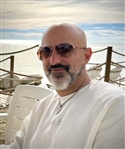
Joseph Michael is a social worker and writer from Brooklyn, NY. Born into a Sicilian immigrant Catholic family, he attended parochial school throughout his childhood. He studied Journalism at Arizona State University and completed a Culinary Arts degree through Le Cordon Bleu, working for over a decade in restaurants and country clubs throughout California, New York and Wisconsin. He then earned an M.A. in Pastoral Counseling at Fordham University followed by a Master of Social Work degree from New Mexico State University. A writer since high school, his work has focused primarily on faith-based and political commentary. He has worked extensively in the mental health field, providing therapy in residential treatment facilities, behavioral health hospitals and clinics and now works as a crisis interventionist in correctional healthcare. He and his wife, also a social worker, reside in Arizona. Joseph is a Knight of Columbus and has strong devotions to Our Lady, St. Padre Pio and St. Michael. He plays ice hockey, watches baseball, cooks and does martial arts in his free time. Feel free to contact him at jdimarius@fordham.edu.