A Prayer for National Repentance
Sponsored

Catholic365 is sponsored by
Road to Purity



Renewed Again – Part 2
In the first part of this essay, I stated that this is an opinion piece. I will take full responsibility for my opinion. I cannot take responsibility for how others may receive or reject what I say here. We will continue looking at the Sacrament of Reconciliation – Confession. We left off with a recollection of "seriously grave matters," and the Church's definition of the criteria for evaluating our actions to determine if they are "Mortal Sins."
Can YOU name the Seven Mortal Sins without Google? For that matter, can YOU name the Seven Cardinal Virtues without Google? Can your Priest or Pastor? Can your children or your spouse? I'm going to recommend a handy website that tells us in a very straightforward way how we can examine our conscience and spot those grave acts of defiance. It is called CATHOLICS STRIVING FOR HOLINESS (↔ Click Link). I believe you'll find a good number of useful things there. One of the things that sometimes surprises people is that Catholics have a list of the Ten Commandments that differs from the non-Catholic list (don't blame it on the reformation). Here is "our list" of ways to defy God and break The Whole Law.
Catholic Ten Commandments:
I am the LORD your God. You shall worship the Lord your God and Him only shall you serve.
You shall not take the name of the Lord your God in vain.
Remember to keep holy the Sabbath day.
Honor your father and your mother.
You shall not kill.
You shall not commit adultery.
You shall not steal.
You shall not bear false witness against your neighbor.
You shall not covet your neighbor’s wife.
You shall not covet your neighbor’s goods.
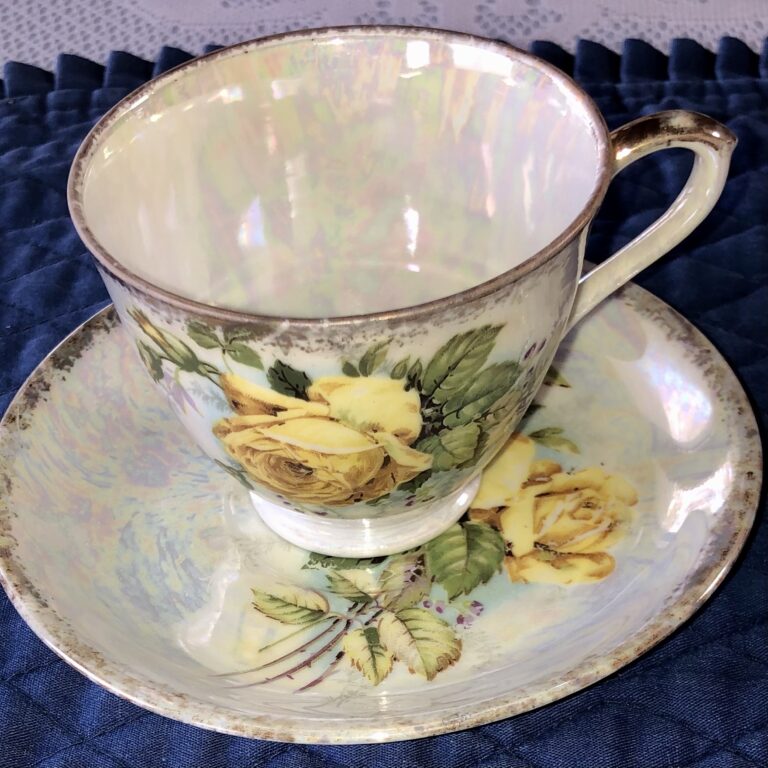
Here's an illustration to help us understand. It's called "Auntie's Teacup." (↔ Click Link) Think about your Auntie's favorite tea cup, the one beautifully decorated with floral designs, hand painted, wonderful glaze, and a matching saucer. As you recall its appearance, remember that it has an inside and outside; it has a handle, a lip, and a foot. The painting is detailed and there are images on the front and back of the cup. Then there is the saucer. The cup and the saucer actually belong together and are designed to match.
Now, imagine you were washing her cup after she's had her oolong tea and a palmier, and as you put it back, you knock a triangular piece out of the back side of the cup. The cup is broken. It can be glued together, but it is still a broken cup – but with a repair. Even if the damage was only to scrape away part of the flower off the saucer, the set is damaged, ruined; it is a broken set. It is one cup that has many parts, and only one of the parts is slightly broken. Auntie can still drink tea out of it, but it will never be the same. Her cup is broken. Even if you apologize profusely, the cup is broken. Even if she says "It's OK dear. It's only a teacup," you know that's not quite right. It is not "just a teacup." It is her favorite. You tried to take care of it and you broke it. Just one teacup with many parts. The whole cup and saucer set has been broken – even if the cup hasn't been "smashed to smithereens," it's broken.
That is like the Law of God, the Law we call the Ten Commandments. It is one Law with several parts. Anytime we break one of the parts, we have failed to keep "The Whole Law." Let's recall what Jesus said to the rich young ruler in Mark 10:19-21 – 19 You know the commandments: ‘You shall not murder; You shall not commit adultery; You shall not steal; You shall not bear false witness; You shall not defraud; Honor your father and mother.’” 20 He said to him, “Teacher, I have kept all these since my youth.” 21 Jesus, looking at him, loved him and said, “You lack one thing; go, sell what you own, and give the money to the poor, and you will have treasure in heaven; then come, follow me.” The wealthy man went away deeply saddened because he had many possessions. He thought he had kept The Whole Law. Jesus told him there was one more part to live: Love your neighbor. Years later, the Apostle Paul would write Galatians 5:14 – 14 For the whole law is summed up in a single commandment, “You shall love your neighbor as yourself.”
No one can “keep the whole Law” for the Law brings condemnation, and Salvation is only from God. Nonetheless, even through Salvation, we are not excused from the Law. The Law is fulfilled in Christ, by Christ, and through Christ. But in Matthew 5:17-18, Jesus says, 17 “Do not think that I have come to abolish the law or the prophets; I have come not to abolish but to fulfill. 18 For truly I tell you, until heaven and earth pass away, not one letter, not one stroke of a letter, will pass from the law until all is accomplished. To be quite direct about it, the passage says that Jesus alone fulfills The Whole Law – all the moral obligations and all the ritualistic obligations – and that none of the Law would be abolished until it – God’s plan of redemption and Salvation called The Law – was fulfilled. I restate that as "all of the Law is still there." And it is not difficult to infer that the consequences of compromising the Law are still there as well. If we fail to love and serve God, and/or fail to love and serve our neighbor, we have broken The Whole Law. There is a distinction, though, between the outcome for Auntie's teacup and our own brokenness. The teacup can be repaired. We can be restored. That is the main reason we go to confession. If you forgive the sins of any, they are forgiven them; if you retain the sins of any, they are retained. We are not repaired. We are restored to a state of grace. All our sins a G-O-N-E – GONE. God has forgiven and forgotten the stupid, hurtful, unlawful things we have done. That's a pretty good deal for submitting to 12 minutes of humility with the Alter Christus. "10 Create in me a clean heart, O God, and put a new and right spirit within me. 11 Do not cast me away from your presence, and do not take your holy spirit from me. Psalm 51:10-11 God answers that prayer in the Sacrament of Reconciliation.
I want to switch gears, now, and say that it's not 100% the responsibility of the guy in the pulpit or ambo to teach us about sin. First and foremost it is the PARENTS' responsibility to teach their children all the things they must know about sin and Salvation. We have catechists to help the parents, and most of them are lay persons with special training – not to mention devotion to the Lord and to the Church. But where do the parents get their education? In the homilies and sermons, we hope, as well as their continued active participation in the Mass, in Catholic catechesis, and in the confessional. It's kind of a "pay to play" situation. Like Adam and Eve, we have to fess up and humble ourselves enough to tell God we let him down again. So let's not pin our reticence entirely on the clergy. We have a responsibility to know we need to accept that Sacrament. There's really no excuse. In fact, let me pose another question we use when dealing with the necessity for social change: What's stopping you? Who or what is preventing you from 1) knowing your personal transgressions and 2) from going to confession? Is it fear? What are you afraid of? Is it personal holiness? Check that at the door of the confessional. Is it because you know the Priest really well and are embarrassed to tell him your flaws? Check that at the door of the confessional, too.
The Church certainly could do a better job of teaching about sin and what to do about it. I'm not entirely advocating for the fire-and-brimstone homiletics that were used as scare-tactics back in the day; I'm talking about gently but honestly confronting the cancel culture and the moral relativism that characterizes all our Worldly relationships and comparing that to the perfect Integrity, endless Mercy, and eternal Salvation that comes only in Christ Jesus. Call a sin a sin, and have a way to deal with it. We must each take it upon ourselves to be educated about the Sacrament of Reconciliation (and all six of the other Sacraments, too!). You say you don't know how? Let me help. Here's another excellent link for FAQ's About the Sacrament of Penance/Reconciliation/Confession. It's not "the protestant's fault," not just the Priest's fault, and – believe it or not – not entirely your fault that there are cobwebs in the confessional. But, there is another very important reason to be sure you have restored your State of Grace, and that is unworthy participation. Here's what the Apostle Paul (and the Catholic Church) says about that: 1 Corinthians11:26-29 – 26 For as often as you eat this bread and drink the cup, you proclaim the Lord’s death until he comes. 27 Whoever, therefore, eats the bread or drinks the cup of the Lord in an unworthy manner will be answerable for the body and blood of the Lord. 28 Examine yourselves, and only then eat of the bread and drink of the cup. 29 For all who eat and drink] without discerning the body, eat and drink judgment against themselves. Instead of being restored and filled with grace through the Eucharist, we are plunging deeper into condemnation by sinning against the Real Presence. That's turning down a fantastic deal for submitting to 12 minutes of humility with the Alter Christus. And that, Belovéd, is a fact and not just an old man's opinion.
Lastly, here is a link to an illustration we have used in our RCIA classes for Children. If you can understand this drawing, then "going to confession" should be a snap. Just click on the link here: Reconciliation
Unless otherwise indicated, all scripture passages are from the New Revised Standard Version Catholic Edition (NRSVCE) New Revised Standard Version Bible: Catholic Edition, copyright © 1989, 1993 the Division of Christian Education of the National Council of the Churches of Christ in the United States of America. Used by permission. All rights reserved.
Chick Todd was reared as a "Baptiterian" in Denver, Colorado and grew up to become an American Roman Catholic. After several years of feeling called to the Roman Catholic Church, I made my First Communion as a Catholic at Easter Vigil in 1969. That happy event was followed two weeks later with the Sacrament of Holy Matrimony with Crucita at Chapel 2 on Lackland AFB in San Antonio TX.
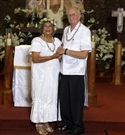
We are shown here at the celebration of our 50th Anniversary which included a renewal of our Vows. During those fifty years we have been Catechists, Extraordinary Ministers of Holy Eucharist, Lectors, and the RCIA/C Coordinators for our Parish, St. Catherine of Alexandria Parish on the island of Kaua'i in Hawai'i.
When we married, we devoted our Marriage Vocation to establishing and maintaining a Christ-Centered Home. It still works that way today. The love we have shared with each other has been multiplied as we share it with others, especially our two adopted children, and all the children and adults we have helped catechize.
I have always been a serious Bible student and now run a blog called The Moon Beam Network at www.aloha-friday.org where I publish a weekly Catholic Bible study every Aloha Friday. Crucita is an exceptional Master Teacher, and so we find abundant opportunities to share our love of Word and Sacrament with many others. Come visit us at The Moon Beam Network. E komo mai!