The Perfect Loser
Sponsored

Catholic365 is sponsored by
Road to Purity



This is part 1 in a series of 2 entitled 'Renewed Again'.
Psalm 51:10 – 10 Create in me a clean heart, O God,
and put a new and right spirit within me.
At the outset, I will state that this is an opinion piece. I will take full responsibility for my opinion. I cannot take responsibility for how others may receive or reject what I say here. I will be looking at the Sacrament of Reconciliation – Confession. The above quote from Psalm 51 should be familiar to all of us. It is one of the great Penitential Psalms. I include the following as an example of how the Apostolic Ministry of Reconciliation was passed forward.
2 Corinthians 5:16-20 – 16 From now on, therefore, we regard no one from a human point of view; even though we once knew Christ from a human point of view, we know him no longer in that way. 17 So if anyone is in Christ, there is a new creation: everything old has passed away; see, everything has become new! 18 All this is from God, who reconciled us to himself through Christ, and has given us the ministry of reconciliation; 19 that is, in Christ God was reconciling the world to himself, not counting their trespasses against them, and entrusting the message of reconciliation to us. 20 So we are ambassadors for Christ, since God is making his appeal through us; we entreat you on behalf of Christ, be reconciled to God.
This of course is based on Jesus' imparting the Holy Spirit on the Apostles as described in John 20:21-23 – 21 Jesus said to them again, "Peace be with you. As the Father has sent me, so I send you." 22 When he had said this, he breathed on them and said to them, "Receive the Holy Spirit." 23 If you forgive the sins of any, they are forgiven them; if you retain the sins of any, they are retained.”
The Sacrament of Reconciliation is solidly supported by Scripture, Tradition, and the Magisterium. It is one of the greatest gifts bestowed on the Church by Christ. However, we all know – because we hear it often and experience it more often – that "these days Catholics don't take advantage of this beautiful Sacrament. Years ago, there used to be long lines of people waiting outside the confessionals to confess to the Priest. Now, hardly anyone goes." And then some will add, "The Protestant's idea of just 'talking it over with God' has taken over their minds." Let's look at those statements.
It is definitely true that not as many Catholics go to confession as in days gone by. I do not think it is happening because Catholics are copying Protestant theology. First of all, let's ditch the word Protestant. The reformation is over, so we have Catholics and non-Catholics. More precisely we have Catholic Christians, Non-Catholic Christians, and non-Christians. I'm certain that most people reading this have been asked as some point, "So, are you Catholic or Christian?" Catholics are, of course, the original Christians of the Apostolic Church, and we have all the Sacraments of the Apostolic Church, too. One of the most misunderstood Sacraments is Reconciliation. Christians in general have a tough time with that concept. How can a man, a Priest, listen to another person – man, woman, boy, or girl – as they tell their deepest secrets about how they've sinned and that man not remember what he was told, not judge the one who told it, and then – on God's behalf – forgive that person? The answer is, "Jesus said so."
Is it uncomfortable to do that? For the Priest, usually no. For the penitent, usually yes. We don't want to admit we're wrong, especially to a guy we see at least (one hopes) once a week. What do we do then? We hide, we deflect, we delay. That's the usual human response to being caught in sin. But we Catholics have a way to get past that! We can confess our sins because "9 If we confess our sins, he who is faithful and just will forgive us our sins and cleanse us from all unrighteousness." (See 1 John 1:9) To whom is this confession made and why? To a Priest, because Jesus said so! (We need to remember that.) So why do we work so hard to avoid it? What is so scary about "going to confession?" I'm offering two opinions about that.
Opinion 1: Not many people can define sin; we don't know for certain if what we did is really a sin. My experience is that not many Christians can name the 7 Deadly Sins; in fact, I think even a few Priests and non-Catholic Pastors would stall on that. If we don't know what sin is, how can we know if we have sinned? And how are we supposed to know that stuff anyway? IN MY OPINION (second one), we would learn that from the guy in the Pulpit, the guy at the Ambo, the guy who is trained to know what sin is and to tell us about it. OK? So truth-test: Can you remember the last sermon or homily given that defined sin and instructed you on what God and his B.I.B.L.E. said to do about it? I'll give you a moment here to reflect ………………, and? If you've got one that's great; if you haven't got one, that's common. Congregations, assemblies, earthlings, … we don't want to hear about sin because it makes us uncomfortable. AFTER ALL WE ARE SINNERS! Blaming it on "Protestant Theology" is a serious cop-out. It's human-nature, not theology, to deny sin and avoid talking about it.
Think about the First Sinners in the Garden. They blamed the Serpent, but it was their sin, not his, that got them kicked out of Paradise. We did, too, for that matter. We won't see Paradise until Jesus comes back to get us as he promised. Adam and Eve knew about their sin – after all they made loincloths out of fig leaves (which must have been very uncomfortable), and they fessed up to it – they confessed. "We heard you in the Garden and we knew we were naked ….."
I think a lot of us do not go to Confession because we don't know what sin(s) we have committed. We can use a spiritual or biblical Examination of Conscience to kind of home in on our sins, but sometimes we fudge a bit on that. "Well, I didn't really intend to do that. It just sort of happened." Hmmm. The Church has given us some fairly simple guidelines about sins that should be (read must be) confessed. "An utterance, a deed, or a desire contrary to the eternal law" (taken from St. Augustine's writings) is a mortal sin, when the following three elements are simultaneously present: 1. It is a grave matter, the moral object or content of the action is seriously evil; 2. We have full knowledge (or full advertence) - one knows what he or she is doing, and its serious evil content; and 3. We suppress our conscience and give full or deliberate consent – one accepts or tolerates what he or she is doing. "I knew it was wrong, but I did it anyway." Are we unsure of what "counts" as a grave sin and don't want to wade through The Catechism of the Catholic Church to get the answers? (↔ Click Link) How about looking thorough an abridgment of those pertinent sections. Here's how to get started using this link. (Link is repeated in the second section; see "STRIVING")
What is grave these days? It is the same things that have been grave for millennia: The Ten Commandments. Remember, if we break one, we have broken the Law. They are commandments, not recommendations, and they come as a package deal. (See CCC1858) when we look at those commandments and fudge a little about what really happened, that's when the trouble begins. Two of the most famous public examples in recent times involved the 6th commandment – You shall not commit adultery. One U.S. President admitted seriously grave actions but stopped short of admitting adultery. Another U.S. President admitted to "lusting in his heart," and repented of that. He was remembering Jesus' teaching on that sin of Lust when Jesus said in Matthew 5:28 – 28 But I say to you that everyone who looks at a woman with lust has already committed adultery with her in his heart. Neither of these men went to a Priest for the Sacrament of Reconciliation. Were their sins forgiven? Only God knows, and for now he's not telling.
It really shouldn't take much reflection to decide if we've broken any part of The Whole Law. A good review of that list referenced above should so the trick. We should mention though that some folks aren't so sure that their local confessor is up to snuff. Let me give you some examples I've been told. All of these could begin with, "I'm not sure my Priest is right because …"
Given one or any combination of these could cause one to wonder if our confession is really heard and the graces imbued in the Sacrament are really bestowed. How can either one of us know if I've truly committed a Mortal Sin? And how can I confess it if I don't see it? We'll deal with the answers in Renewed Again – Part 2
Unless otherwise indicated, all scripture passages are from the New Revised Standard Version Catholic Edition (NRSVCE) New Revised Standard Version Bible: Catholic Edition, copyright © 1989, 1993 the Division of Christian Education of the National Council of the Churches of Christ in the United States of America. Used by permission. All rights reserved.
Chick Todd was reared as a "Baptiterian" in Denver, Colorado and grew up to become an American Roman Catholic. After several years of feeling called to the Roman Catholic Church, I made my First Communion as a Catholic at Easter Vigil in 1969. That happy event was followed two weeks later with the Sacrament of Holy Matrimony with Crucita at Chapel 2 on Lackland AFB in San Antonio TX.
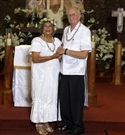
We are shown here at the celebration of our 50th Anniversary which included a renewal of our Vows. During those fifty years we have been Catechists, Extraordinary Ministers of Holy Eucharist, Lectors, and the RCIA/C Coordinators for our Parish, St. Catherine of Alexandria Parish on the island of Kaua'i in Hawai'i.
When we married, we devoted our Marriage Vocation to establishing and maintaining a Christ-Centered Home. It still works that way today. The love we have shared with each other has been multiplied as we share it with others, especially our two adopted children, and all the children and adults we have helped catechize.
I have always been a serious Bible student and now run a blog called The Moon Beam Network at www.aloha-friday.org where I publish a weekly Catholic Bible study every Aloha Friday. Crucita is an exceptional Master Teacher, and so we find abundant opportunities to share our love of Word and Sacrament with many others. Come visit us at The Moon Beam Network. E komo mai!