God Alone Suffices: Living a Life of Poverty

To paint the face of the Blessed Trinity

Holy Trinity Sunday Year A
Gospel, John 3:16-18
16 For this is how God loved the world: he gave his only Son so that everyone who believes in him may not perish but may have eternal life.
17 For God sent his Son into the world not to judge the world, but so that through him the world might be saved.
18 No one who believes in him will be judged; but whoever does not believe is judged already, because that person does not believe in the Name of God's only Son.
The face of the Holy Trinity
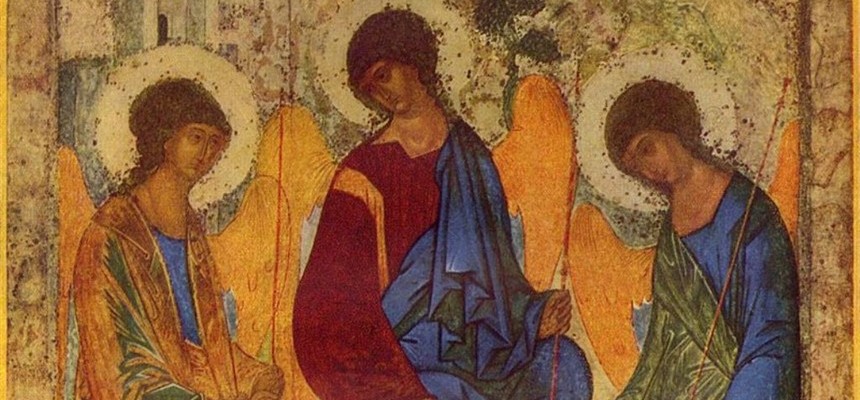
This religious icon or painting shows three persons having a conversation while sharing a meal. They look slightly different from one another by the way they are portrayed, however identical. They have wings and easily we identify them as angels. They hold a long rod or staff as a symbol of divine power, and their clothes colored differently.
Behind this classic icon prefigures this truth: Troitsa, also called The Hospitality of Abraham) is an icon created by Russian painter Andrei Rublev in the 15th century. ... The Trinity depicts the three angels who visited Abraham at the Oak of Mamre (Genesis 18:1–8), but the painting is full of symbolism and is interpreted as an icon of the Holy Trinity.
Based on its ancient iconography, each figure expresses a particular attribute of God without Him being represented. In this icon, we are in God's presence, but He is invisible. This piece of art depicts God the Father, God the Son, and God the Holy Spirit. All three figures illustrated here possess identical features. This is not a mistake: the three persons of the Trinity are identical, each fulfilling its own particular role. The one on the left is the Father; the middle the Son, and the one on the right the Holy Spirit. These are the few meanings in this enigmatic yet profound iconography as created by the artist with a subtle undertone of rich Theological realities.
A picture such as this will only give a glimpse or brief overture of the story. The Holy Trinity has a dynamic movement that is basically transcendent and immanent. The love They share defines their relationship which is intimate and united. Thus, this interior exchange will never be understood based on whatever picture we paint behind this active exchange based on the love they share. Pictures paint a thousand words. These lyrics from the song: "IF" sums up the immensity and characteristic of why this mystery of all mysteries, where the heart of all doctrines is based upon and the feast of all feasts directly describes this Divine union. "If a picture paints a thousand words then why can't I paint you? The words will never show that you I've come to know." The picture is not everything. We know the person when we relate to him or her. We translate in a picture the people we relate with.
If God's love brings forth His creation of the world, making us in His image and likeness, constantly searching for His children who are also called to love, to glorify and serve Him, we have the same love to some extent to exercise according to what Jesus, HIs Son has performed while His Holy Spirit provides us the strength and the grace to make that love concrete and fruitful, our lives become the embodiment of that truth, that God's love is like a picture made by the heart and mind of someone who has an intimate encounter with His Creator. And purposely not only to enhance and display which is already obvious while it is still on progress and unconsummated.
What kind of picture we can draw or paint to describe God? Is this the same picture we make with each other to describe our relationship? Will His love reflect on this unfinished picture and to allow God to paint in the canvas of our communion and mission?
Recommended Stories
About the Author
I am Fr. Jude M. Serfino, a diocesan priest from the Diocese of Bacolod, Philippines, currently endorsed by Archdiocese for the Military Services, USA. assigned as the contract priest at St. Michael's Catholic Community, Camp Pendleton, California.
More Stories By :