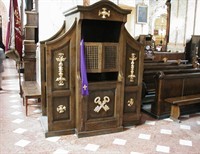
Confession: my meeting with Jesus

The Importance of Perseverance


Photo By: Flickr/Hans Dinkelberg
Do you find yourself going to the Sacrament of Confession with the same habitual sin, month after month, maybe even week after week? Whatever they may be, we ALL struggle with bad habits, and Our Lord Jesus Christ certainly calls us to live as God’s children, loving Him with all that we are and all that we do, and to care for our neighbor as we care for our own welfare (Mark 12:28-31).
As we each embark on our journey as disciples of Christ, we inevitably rub up against our own particular faults that we have become so accustomed to repeating in our lives. Whether they are venial sins or mortal sins, overcoming these vices of ours is not always as easy as deciding “I don’t want to do this anymore.” Sure, we bring these sins to Confession with a sincere desire to do better, yet we find ourselves falling into those same habits again and again, and so we go to Confession again and again. We tell God we are sorry, again, and we resolve not to commit the sins that we brought to our last Confession (and our Confession before that, and the one before that).
After a while of going through this four-step process of trying-sinning-confessing-repeat, Lucifer (or one of the other fallen angels) often tries to inspire despair. He can do this by getting us to doubt our own resolutions: “You say to God that you don’t want to gossip with your friends again, and you keep letting Him down. You are a hopeless case and you should just quit now, why lie to Him again?” One priest whom I know well sometimes tells me: “The devil has many faces, first he gets you to sin by telling you how good it will make you feel, and then after you sin he tells you that you’re no good and God doesn’t love you anymore.” So, what is an imperfect Catholic to do in such a situation?
I am very fond of the Devotion to the Divine Mercy, and in St Faustina’s Diary can be found the “Conversation of the Merciful God with a Soul Striving after Perfection” (Diary of Saint Maria Faustina Kowalska, 1488). I would encourage you to read the whole passage, but for now I am going to pull a quote directly from Christ which should prove to be very illuminating. The soul has just told Jesus that she is sad because she falls into the same sins over and over again (sound familiar?), and, out of love and compassion for her, Jesus replies:
[…] You see, My child, what you are of yourself. The cause of your falls is that you rely too much upon yourself
and too little on Me. But let this not sadden you so much. You are dealing with the God of mercy, which your
misery cannot exhaust. Remember, I did not allot only a certain number of pardons. [...]
(Diary of Saint Maria Faustina Kowalska, 1488)
This is very important for us to reflect on. As finite creatures, we can never fully understand the extravagance and infinite nature of God’s Mercy for us, especially with our own, weak capacity to forgive others. When we have to put up with the bad habits of others (especially those whom we live with!), we sometimes get tired of having to deal with them and find it harder to forgive them for those habits as time goes on with seemingly no change. Therefore, because we have a hard time forgiving the bad habits of others (and sometimes because we have a hard time forgiving ourselves of our own bad habits), it seems to us that God will eventually give up on us after a certain point. But God and His Son are not like us. They are willing to forgive us as many times as we need to be forgiven until we are home with Him in Heaven!
So, how do we go forward after we have fallen into one of our bad habits for the umpteenth time? We must have the humility and the courage to get up, keep going, and to trust in the superabundant mercy of Jesus Christ. Part of this means recognizing that our own resolutions and willpower, by themselves, are not sufficient to overcome our bad habits. Our desire to live a holy life that is pleasing to God, is not enough (by itself) to bring about a change of heart and train our wills to choose God’s Will over sin day in and day out. Our desires and resolutions need to be fused with the Grace that Christ won for us on the Cross. That’s why He gave us the 7 Sacraments!!! It is also important for us to realize that Christ knows our weaknesses better than we do. He knows our resolutions are frail, and He wants us to come to Him, trusting that He loves us enough and that He is powerful enough to make us into Saints, even if the process seems very slow to us. God’s timing is not always our timing.
Whenever I find myself falling into a habitual sin, I like to imagine Christ, suffering through His Passion, freely offering His forgiveness to me, just as kindly as he did all those other times I fell. This reflection inspires sorrow for sin, because I want to be a good friend to Jesus after all that he has done for me. It also inspires trust in His Goodness, because I know that he knows that I’m struggling with a bad habit, and that I don’t always try as I should, and that He wants to help me anyway. He is especially pleased when I come to Him, recognizing my own moral weakness and trusting that He will help me simply out of His love and compassion for me (remember, we cannot earn God’s grace or love by anything that we do). I will conclude with one of my own acts of contrition. Take in the words, calling to mind the infinitely merciful Christ, who is more eager to forgive you and to help you than you are to be forgiven or helped. Maybe He has some special blessings in store for you:
“My dear Jesus, I am so sorry for making such a poor return for Your Love yet again. I want to be Your good friend, and I
want to make you happy by living a holy life. However, my own desires and willpower are insufficient. Because You love
me so much and because Your grace is all-powerful, please help me to be truly sorry for my sins, to change my life for the
better, and to keep getting up after my falls. Amen.”
Works Cited
Kowalska, Maria Faustina. Diary of Saint Maria Faustina Kowalska: Divine Mercy in My Soul. Marian Press, 2018.
Senior, Donald, et al., editors. The Catholic Study Bible: The New American Bible Revised Edition. Oxford University Press, 1990.
Recommended Stories
About the Author
I am a seminarian for the Diocese of Orlando, studying at Pope St. John XXIII National Seminary. I am also a proud 4th degree member of the Knights of Columbus. My hobbies are exploring historical cities, singing, and reading books on history, ghost stories, and Jane Austen novels.
More Stories By :