IVF, the Alabama Supreme Court, and Catholic doctrine
Sponsored

Catholic365 is sponsored by
Road to Purity




Recently, two different friends contacted me separately asking for prayers related to health; both found out about potentially life-threatening matters. I elected to say a rosary - a special series of prayers primarily directed to Mary - for each of them; their health, their families, and their doctors.
But, why? Why pray to Mary and not to Jesus directly?
As a practicing Catholic, I look to the whole Bible, not just the Old Testament (like my Jewish friends may) or the New Testament (as some of my Protestant friends may). Scott Hahn quotes St. Augustine as saying, “The New Testament is concealed in the Old; and the Old Testament is revealed in the New.” So, when seeking to justify my faith practices, I often look to the Old and the New together.
Said another way, the Old Testament prefigures the New; people in the New Testament remind us of their Old Testament ancestors, but perfect what they may have been lacking.
So, we begin in the old. In 1 Kings 2:19-20, we read about King Solomon’s first acts after succeeding his Father David to the throne of Israel. Recall this scene between King Solomon and Bathsheba his mother (which, coincidentally, occurs before Solomon asks God for wisdom):
“19 Then Bathsheba went to King Solomon to speak to him for Adonijah, and the king stood up to meet her and paid her homage. Then he sat down upon his throne, and a throne was provided for the king’s mother, who sat at his right.
20 She said, “There is one small favor I would ask of you. Do not refuse me.” The king said to her, “Ask it, my mother, for I will not refuse you.”
In this passage, we see how a king treats his mother. On her entry to the throne room, he pays homage to her (bowing?) and provides her a throne on his right. He then tells her to ask anything of him; he will not refuse her. She is the Queen Mother, an advocate for the people.
If Solomon was a great king, how much greater is the King of Kings? If Solomon was a wise lord, how much wiser the Lord of Lords? If Solomon treated his mother this way in the Old Testament, how much better would Jesus treat his mother?
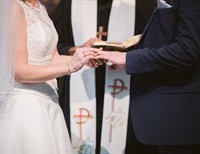
We see how Jesus treated his mother at his first recorded public miracle - the wedding feast at Cana. The second chapter of John’s gospel states:
“2 Jesus and his disciples were also invited to the wedding.
3 When the wine ran short, the mother of Jesus said to him, “They have no wine.”
4 [And] Jesus said to her, “Woman, how does your concern affect me? My hour has not yet come.”
5 His mother said to the servers, “Do whatever he tells you.”
Jesus then blesses the water into wine; his first publicly recorded miracle. But, if his hour had not yet come, why did he do it?
As a Catholic, I suggest he did it because his mother asked him too.
Much ink has been spilt over this passage from John's gospel; Catholic and Protestant alike. We could debate whether Jesus was being disrespectful to Mary by calling her woman (note: he wasn't; and wouldn't tweak the fourth commandment). We can discuss whether Solomon was truly good to his word to doing what his mother asked (note: he's the Old Testament prototype that prefigures, so he's imperfect). We can discuss whether it's better to just ask Jesus directly.
We can, of course, ask Jesus directly, just as she did and just as we sometimes do. But, we know she’s holy, we know she’s with him in heaven, perhaps at his right hand, and we know he listens to her.
So, asking her to ask him for us just seems right.
The author is an attorney who lives in the Midwest with his wife and children. A cradle-Catholic, he left the Church as a young adult, but came back to the fold and now fully lives his faith.
The author chose this pseudonym as a way to describe his writing, which he hopes will guide him in all his articles, which will in turn lead others to God.