Faith is a two-way street

The freedom to hope


Photo By: Flickr/Rubén Cañizares Jiménez
I recently finished reading The Everlasting Man by the early 20th century Catholic apologist G.K. Chesterton. I like to read Chesterton because he makes me think about things that deserve far more thought than I typically give them. The case in point this time is hope.
In the book Chesterton argues that of the three theological virtues—faith, hope, and love—only hope is unique to Christianity. His specific argument is that Christianity differs fundamentally from the pagan mythologies and Eastern philosophies that preceded it because Christianity gives hope whereas these older belief systems did not.
I had never thought about it that way, but once the idea was brought to my attention it really seemed quite obvious: Hope is not possible without freedom; and those who embraced these ancient beliefs were not truly free. The pagans of ancient Greece, for example, populated Mount Olympus with capricious and manipulative deities whose king was a terror to humanity and a notorious serial rapist. Divine oppression was the ancient pagans’ mythology, their explanation for the nature of the world and the human condition. They were enslaved by the whims of their gods, and in the end all they received for their trouble was a coin to give the ferryman to shuttle them across the Styx.
The Eastern philosophers also enslaved humanity by locking us into a perpetual cycle of death and reincarnation. They sentenced us to ride through existence on a carousel, with each individual life passively tracing a horse-driven sine wave. The calliope never goes silent; the circuit never ends. The only thing that changes is the horse we are riding; and it’s not ours to decide which horse to mount next.
Pre-Christian humanity was hopeless because it believed it was helpless, exchanging free will for impotent fatalism. There is no hope for one waiting on the bank of the Styx. Charon’s ferry goes only to the bleak and tragic Kingdom of the Dead. Likewise, there is no hope for the reincarnated soul. Even if that soul tried to alight from its steed, there is nowhere to go beyond the spinning platform.
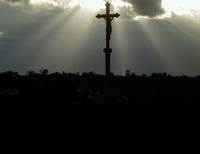
All of that changed when the Word became flesh and Christian hope entered the world. Christians are free to hope because Jesus purchased our freedom. Through his death and resurrection Jesus changed the world by showing us that there is more than the world. He reminded us of our free will and then gave us the opportunity to choose the better part. The Light pierced the darkness that engulfed us and gave us the freedom to hope.
Still, paganism has not been eradicated. Lives continue to be lived without Jesus; and in his absence golden calves that intrinsically have no moral valence are made evil by elevating them to the status of godhood. This kind of worship is not motivated by faith but by addiction, where hope for better is supplanted by need for more—more money, more influence, more “likes”. It’s a downward spiral that can lead only to despair; and every one of us at one time or another has gotten caught in this trap.
But we have an advantage over our pagan ancestors: We already have the freedom to hope, which is our greatest strength and our most glorious joy. That is a fundamental truth that we need to remember when our hearts are restless and we feel trapped in our lives. Liberty always is in reach. All we need to do to defeat the false god that has imprisoned us is accept the hope that Jesus has given us and let the Holy Spirit set us free.
Recommended Stories
About the Author
Denise and her husband Andy are life-long residents of Pittsburgh, PA. Both belong to Assumption Parish in Bellevue, PA, where Denise also serves as a CCD teacher.