The forgotten Key, Our Eucharistic Lord

True Religion, Everybody's Got an Opinion!


Photo By: Flickr/vishal charles
First, let me explain that English is a rather sloppy language. An English professor I once knew described it as a “bastard language,” a Latinate language with a German syntax. Latinate, rather than Latin because we didn’t get our Latin from the Roman invaders, no, we got our Latin from the Norman French conquerors! So we started out with modified Latin given different meanings by the French, and modified still further by the Vikings. which brings me to the subject of this ramble!
Religion! From the Latin religio! The term originally meant, according to Cicero, to “choose", "go over again" or "consider carefully". Julius Caesar used religio to refer to the oath of loyalty to Rome taken by captured enemy soldiers! So, how did religio, religion, get into our English lexicon and what, exactly, does it mean?
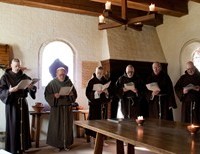
Religion, the anglicized version of religio, first showed up in English referring to those who had taken vows of special devotion, to live under a rule of piety. Monastics! Monks and nuns were, from the 12th century onward, referred to as “religious,” in the classical sense, they had considered carefully and chosen to swear an oath! “Vows of religion,” or as we have them today in the Catholic, Orthodox, Anglican, And Lutheran faith’s, “religious orders!”
So far, so good! But! The Reformation happened, separation of church and state, and “religion” took on its modern meaning! The term was used to describe a system of beliefs, or doctrines, as in Calvin’s “The Institutes of the Christian Religion!” Before the Reformation Christianity was simply, the Faith, de Fide! Calvin turned the world on its ear! A thing could be proper in business or governmental affairs, but a sin in one’s personal life! Life was compartmentalized, and one compartment, a personal one, was “religion!” Calvin, was, admittedly, extreme and in modern Protestant usage the doctrines of Christianity are applied more broadly! The compartments are mostly gone and in common usage “religion” simply refers to a set of beliefs or doctrines, as in the Lutheran religion, the Baptist religion. Etc. People who adhere to these sets of belief are referred to as religious, of course “religious” in the original monastic context still applies!
Again so far, so good! Now everybody refers to their particular set of beliefs as their religion, (even Catholics,) did I mention, English is a sloppy language? Of course I did, so far... so...But wait, along came the nondenominationals!! (Funny how a word which means, essentially, “not named,” became a name, did I mention...sloppy language!) suddenly “religion” was replaced by “relationship,” (it always was relationship but we’re talking emphasis.) But still, religion didn’t become a bad word, not immediately anyway! Along with the “nondenoms” came the evangelical movement! Emphasizing the “born again experience,” now we connect relationship with emotion! Religion per se is still okay, but a reaction is coming!
Three trends developed, the first beginning around the turn of the 20th century, the second in the 1920’s and the last after World War II. The first trend was dispensationalism, a system of eschatology developed by an Anglican Minister, John Nelson Darby, and the Plymouth Brethren in the middle of the 19th century, though some claim it’s roots go back to Cotton Mather. Salvation history is divided up into different Dispensations, or Ages. These ages vary significantly from the divisions found in the more orthodox covenant theology, and their eschatology is radically different! Dispensationalism really took off in 1909 with the publication of the famous Scofield Reference Bible! Proponents of Dispensationalism include C. I. Scofield, Lewis Sperry Chafer, Hal Lindsey, and R. B. Thieme Jr. among others.
The second trend, Pentecostalism, blossomed at the Azusa Street Mission in Los Angles. A renascence of the sign gifts of the Holy Spirit; tongues prophesy, and healing, predominately! This movement, characterized by high emotions and experience, was viewed with suspicion by the main line Protestant denominations! Proponents included Aimee Semple McPherson, Smith Wiggleswirth, and F. F. Bosworth, to name but a few.
Lastly, we come to the evangelical, “born again” movement, (mentioned above) focusing on an experience of conversion, and emotionalism, large “tent meetings,” with emotional appeals and “altar calls! To be sure these “tent revivals” date back to the 1920’s with Billy Sunday, but the movement really took off in the 1940’s. The movement lacks the structure and doctrine of the first two trends and generally turns their converts over to a variety of local assemblies! This has led to abuses, and the rise of charlatans, (including Marjo the child actor turned evangelists of the 1970’s, and the infamous Reverend Ike) but, these not withstanding, the greatest proponent of this trend and a paragon of integrity had to be Billy Graham!
I outlined these trends of the 20th century, because they, more than anything else have made “religion” a bad word with their emphasis on personal relationship, and with the exception of Dispensationalism, on experience and emotion. They each have their focus, the end times, the beginnings of the church, and an experience of conversion! They uniformly define religion as a set of rules, salvation by works, a system of legalism, devoid of grace! R. B. Thieme Jr. went so far as to describe religion as “the Devil’s ace trump!” And this is fine, if, and only if, it is made clear that religion is being used as a technical term rather than as commonly defined!!
We have three distinct uses for the term religion, the first classical Christian usage, monastic orders, then, the body of belief, of doctrine, held by a particular group, and finally, a system of salvation by works, we must be specific when we use the term! The first two uses seem obvious, the third, though, is not and could cause ill will and division among believers! We must be careful to note the context in which “religion” is being used in order to avoid confusion, and alienation!
I should, as an aside, confess that I have experience, both good and bad, with all three of these trends. I was “born again at a Billy Graham crusade at the age of ten, I studied dispensations under R. B. Thieme Jr. for nearly two decades, and for many years I attended Pentecostal churches. To this day I consider Billy Graham my spiritual father, and Bob Thieme, one of my greatest mentors but, given all that, I am today, having embraced true religion, blessed to be a Catholic!! Thanks be to God!
As I said early on, religion, the Christian religion, is relationship! Religion, in its truest sense is, simply, as the old Baltimore Catechism tells us, to know, love, and serve God in this life and to live with him forever in the next! To accomplish this we must as, St. Paul instructs us, know nothing, save Christ Jesus, and Him crucified!
Recommended Stories
About the Author
I am a convert to Holy Mother Church, and, as you may know, converts make the worst zealots!
It was the Blessed Virgin, the Immaculata, who brought, rather, dragged me, into the Church! I am her servant, her knight, her Miles Immaculata!
I believe, like the character, Curly, in "City Slickers;"
Curly: One thing. Just one thing. You stick to that and the rest don't mean (a thing)
Mitch: But, what is the "one thing?"
Curly: That's what you have to find out.
For me, that is "Christ Jesus, and Him Crucified!"